Why Does My Team Do the Same Job Three Different Ways?
Because the rule is in your head, and they cannot read it. Your team is not ignoring your standards. They are working to their own, and every one of them believes they are doing what you want.
So this is not a team problem. It's a rule problem, and the fix is not another conversation.
You know the Monday morning. Three jobs done three different ways. The bay you wanted clean is half clean. The car was booked in differently to how you'd have done it. The job card looks nothing like your version. And you have the same thought you have had every Monday for six months: why don't they do it the way I want it done?
Then you roll your sleeves up and fix it yourself, or you pull someone aside and have the conversation you had with them three weeks ago.
Why doesn't anyone just ask me?
Because that's not what people do.
When there is no clear rule in front of someone, they don't freeze. They don't put the spanner down and walk to your office to ask how you want this one. They keep moving and do what they think needs doing, in the way they think you want it done.
They fill in the blank themselves. Everyone does.
The five rule books
There is one rule in your head and five versions of it running side by side on your floor every day. And every person is trying to do the right thing.
Your apprentice has the rule book his old boss taught him. Your senior technician has one he worked out himself over twenty years. Your service advisor has one built to make customer calls go smoothly. Your office person has one built so the paperwork stays tidy and nothing gets missed. Your other technician has one built so he doesn't get found out or yelled at.
And you have yours, which is the one nobody has heard, while you stand there wondering why nobody plays by it.
One of our Engine Room members was about ready to put his fist through something. Third complaint in three weeks, a car gone out without the wheel nuts checked properly. He pulled all three technicians into the office at once, ready to come down hard.
Then he made a mistake that saved him. He asked each one to show him how they checked wheel nuts.
The first had a method he learned at TAFE. The second had one his old foreman drilled into him. The third had one that simply made sense to him. Three methods, one shop, one bay, one week.
Not one of them was the method he thought he was paying for. He had shown them once. He had corrected someone more than once. The actual standard, the this-is-how-we-do-it, had never left his head.
Each one thought he was doing what the boss wanted. That gap, between what your team thinks you want and what you actually want, is where every bit of your frustration lives.
Watch: I draw out the five rule books and the three rungs, in about 22 minutes. If you have had the same conversation with the same person twice, this is why it didn't stick.
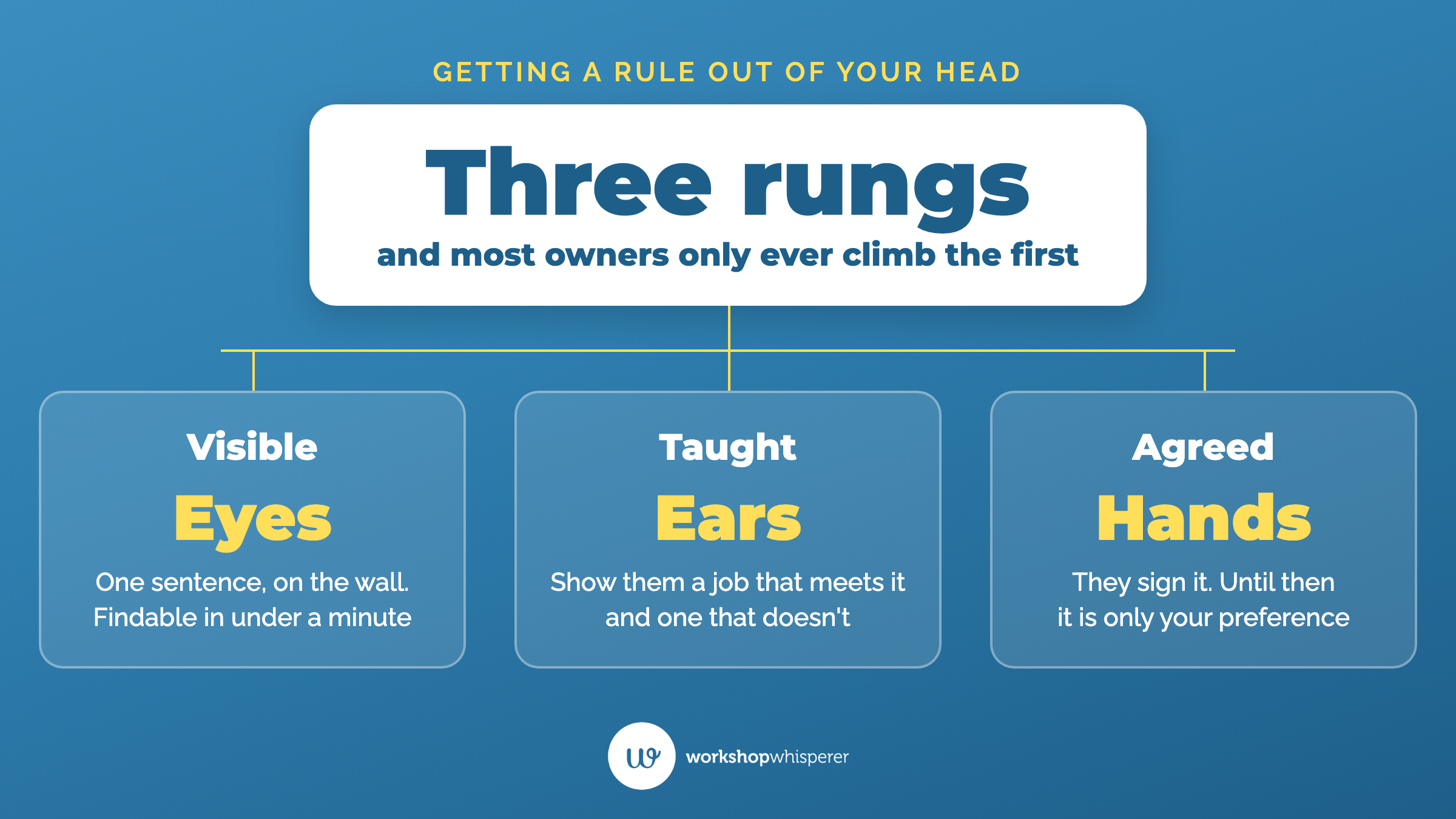
Three rungs, and most owners only climb one
A rule is not a rule until it is shared. Getting it out of your head takes three steps, and skipping any of them leaves you where you started.
Visible. Written down, usually in one sentence, and on the wall. Not in a folder. Not in a document nobody opens. Not on the back of a job card. Anyone should be able to walk into your mechanics workshop and find the standard inside a minute. If they can't, it is still in your head.
Taught. Words on a wall are not a standard. You demonstrate it. You walk the team through what right looks like, what finished looks like, what done actually involves. Then you show them a job that meets it, and a job that doesn't. Most owners skip that second half. They show good and never show the contrast, then get annoyed when people land somewhere in between.
Agreed. This is the one almost everybody misses. The team has to agree to the standard, having seen both versions. Not nodding. Not an eye roll. They sign it. They initial it. They talk it back to you in your words.
Until they agree, it is your preference. The moment they sign, it becomes the shop's standard. Visible brings eyes, taught adds ears, agreed adds hands. It stops being "Dean wants the bench wiped" and becomes "this is how we leave the bay in this shop".
Process plus performance equals profit
That's one of our frameworks, and this is exactly where it bites.
You cannot have process if it only exists in your head. You cannot have team performance if five people are working to five standards. And you cannot have the profit if every job that goes out costs you an hour of rework or twenty minutes on the phone apologising.
The process is the rule. The performance is the team hitting it. The profit is what turns up at the end of the month once the shop stops running on guesses. All of it starts on that wall.
What one sentence did
Another Engine Room member had cars going out clean from some technicians and average from others. Exactly one bloke, the one who had been there ten years, was wiping dashboards and vacuuming mats.
He sat down one Sunday afternoon and wrote a single rule:
Every car leaves with the dashboard wiped, the floor mats vacuumed, and the seat reset to where the customer was sitting.
One sentence. On the wall Monday. He walked the team through it, showed them a car done right, showed them one that wasn't, and asked everyone to sign it.
By Friday every car was going out the same way.
Questions owners ask
Isn't this just micromanaging?
It's the opposite. Micromanaging is standing over someone because they cannot know what you want. A written, taught, agreed standard is what lets you walk away, because the rule is on the wall rather than in your head where only you can check it.
I've told them a hundred times. Why isn't that enough?
Telling is not teaching, and neither is correcting. Both happen after the fact, to one person, without the contrast. A standard that lives in corrections is being rebuilt from scratch in five different heads every week.
How many of these should I write?
One. Start with the thing that annoys you most often and write a single sentence. Get it through all three rungs before you write a second. A wall of twenty unagreed rules is the same as no rules, with more paper.
What if someone won't sign?
That is worth knowing, and far better found now than in six months. Usually it means they disagree with the standard or they don't believe it will be held, and both of those are conversations you want to have while the standard is still new.
Does this work in a garage with two people?
Yes, and faster. Two people means two rule books, and the gap between them is the same gap. The difference is you can get it visible, taught and agreed in an afternoon.
The shift
Your team is not working against you. They are filling in a blank you left, with the best version they have, and every one of them thinks they are helping you win.
Tonight, pick the thing you have corrected most often this month and write it as one sentence. Not a procedure. One sentence. Put it on the wall tomorrow, show them both versions, and ask them to sign it.
That's the whole method, and it works in an automotive workshop of any size.
Want to see owners who have built this out across their whole shop? Our clients are named auto repair shop owners, on camera, telling you what changed.
More on this topic: all Systems articles.
Whenever you're ready, here's how we can help.
- Free. Shop Talk, a 30 day reset for auto repair shop owners, and our free resources.
- Under $50,000 a month? Auto Superstars Academy, $997 one off.
- Over $50,000 a month? The Engine Room, where we build the standards with you in the format we teach, with one on one coaching on demand from a business coach who is a current or former auto repair shop owner.