
Why Does My Auto Repair Shop Stay Busy But Never Grow?
Because a busy shop and a growing shop are not the same shop, and almost everything you did last month was spent protecting the one you've got rather than building the one you want.
You can be the busiest you have ever been and going nowhere. You have probably already lived it.
This is not a time problem. It's a planning problem, and the difference between the two decides whether your mechanic workshop grows or runs in circles.
You know the days. The phone rings while a customer is standing at the counter, a technician is off sick, and a job that should have gone out yesterday is still on the hoist waiting for a part. So you do what you have always done. You put out the fires, one after another, and putting them out feels like work. It even feels productive.
Then you get to the end of the month, look at what's actually in the bank, and it doesn't match how hard everyone worked.
Why do the fires never stop?
Because nothing underneath them changed.
A fire starts, you run over, you put it out. Tomorrow there's another one. Next week another. Next month, next quarter, next year, round and round. It feels like progress and you are not getting anywhere.
Firefighting is also addictive. It's urgent, the problem is obvious, and you get a little hit of "sorted that". You already know this in your bones if you are the owner who is first in and last out, flat out, never stopping, and still cannot take a week off without the phone going mad, because every answer lives in your head. The way to put out each fire leaves the building when you do.
That owner is not running a business. They are the fire brigade.
What does planting a seed look like?
Nothing. That's the problem with it.
Plant a seed and nothing happens today, or tomorrow, or the day after. There's no hit, nothing to tell yourself you sorted. It can look like you did nothing all week.
It is also the only thing on the board that grows.
The owner who put a proper booking system in place planted a seed, and now the front counter does not catch fire every Monday. The owner who trained a second service advisor to quote planted a seed, and now the phone doesn't have to reach them on a day off. Every fire you stop having to fight started as a seed somebody planted months ago.
Look at last week honestly. How much of it was fires, and how much was seeds? When our members do this they usually get a shock, because it's around 90% fires. That's not a character flaw. It's what happens to anyone with no plan.
Watch: I go through the whole game plan funnel, the five inputs and the strategic questions, in 20 minutes. This is the process we run our Engine Room members through at the intensive.
What goes into a plan that actually works
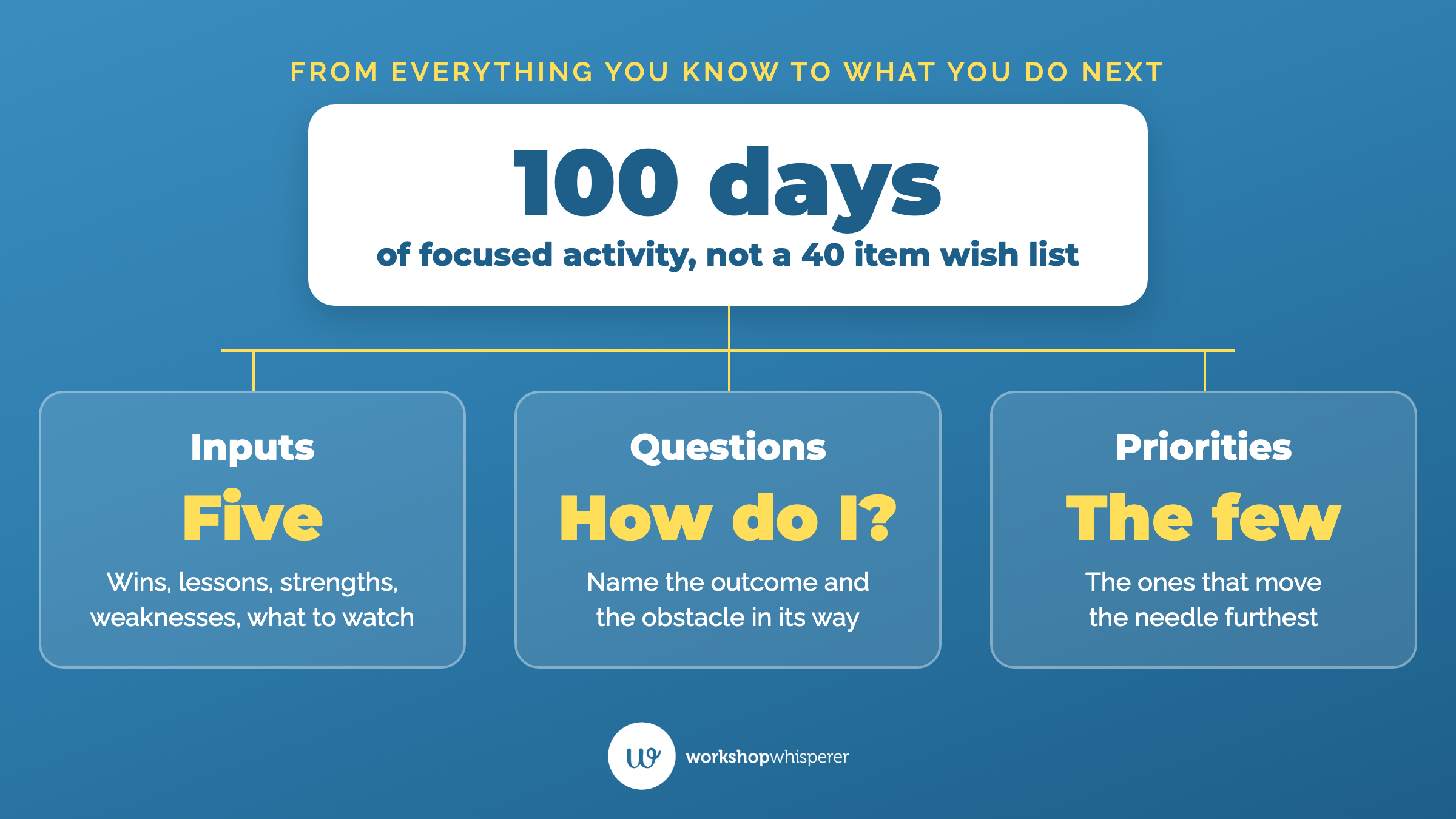
Not a 40-item to-do list. Not a wish list for one day when. A smaller number of the right things, chosen on purpose, for the next 100 days.
Five things go in at the top.
Your wins. What you completed, what progressed, what worked over the last 3 to 12 months. You look in the rear-view mirror first, because direction starts with knowing how far you have already come.
Your lessons. The ah-ha moments that came out of the uh-oh moments. What did the unplanned ones teach you?
What you do well. Honestly. Upsells, keeping customers long term, pricing, efficient and reliable repairs. Whatever it genuinely is.
What you don't do well. With the same unemotional honesty. Most owners produce a far longer list here than for what they do well, and both lists matter equally.
What to keep an eye on. The trends emerging around you, locally, nationally, across the industry and globally. What's coming that could hurt you, or that you could get to before anyone else in your area.
Turning that into strategic questions
Those five pour down into questions, and the form matters: how do I [outcome] given that [obstacle]?
"How do I get my labour productivity up given that it's hard to find talented technicians?" "How do we increase our net profit given that we don't currently measure financial benchmarks?"
You are not solving anything yet. You are putting language around the problem relative to the outcome you want. That's the whole job at this stage.
Then it narrows, because you will have more of those than anyone could answer in 100 days. You keep the magic few: the ones that, solved, move the needle furthest. Those become the plan.
The part that separates a good plan from one that changes the business
Two things, and both are easy to skip.
Knowing whether you're working on the symptom or the source. Most owners pick the problem screaming loudest, the one they take home every night. The loud problem is almost always a symptom of something quieter and considerably more destructive underneath. Telling those apart is the hard part, and it's what twelve years across hundreds of shops buys you.
Somebody holding you to it. Plenty of owners have a plan. What they haven't got is anyone in their corner keeping them on it. A plan with nobody holding you accountable is a wish list you wrote down on a good day. The fire comes back, the plan goes in the drawer, and the seed never gets tended.
Growth game plan plus accountability equals success. Success being progress, big or small, towards a business that is profitable, scalable and sustainable without the owner blowing up, burning out or breaking down.
Questions owners ask
I'll plan when things calm down. What's wrong with that?
They never calm down. That's not pessimism, it's the mechanism: with no plan, nothing stops the fires starting, so the quiet week you are waiting for cannot arrive. The planning has to happen while it's still busy or it does not happen.
How is this different from goal setting?
A goal is an outcome. This names the obstacle in front of the outcome and turns it into a question, then tests whether that obstacle is the real one. Plenty of goals fail because the owner was working hard on a symptom.
Why 100 days rather than a year?
Because an annual plan goes in the drawer by March. A hundred days is long enough to finish something that matters and short enough that you can still see the end of it from where you're standing.
Who can hold me accountable if I'm the boss?
Somebody who will actually check. Not whoever would like to see you do well. A peer, a coach, another owner in the same position. If the honest answer is nobody, the plan will not survive your first bad week, and that is the question worth sitting with.
What if I can only plant one seed?
Then plant one. One system, one person trained, one process written down. One seed that stops a recurring fire gives you back the hours to plant the next one, and that is how it compounds.
The shift
Firefighting keeps you the same. Planting seeds is the only thing that makes an automotive workshop grow. Staying busy protects the shop you have. A plan builds the shop you want.
You don't need more hours. You have plenty of hours. They're pointed at fires.
Three questions to sit down with tonight. How many of last week's hours went to fires and how many to seeds? What's the one outcome you want in the next 100 days, and what's standing in the way? And who is actually going to check on your progress?
If the answer to that last one is nobody, start there. We run a free Facebook group called Your Profitable Auto Repair Shop, full of owners working on exactly this. Come and join us.
Want to see what it looks like on the other side? Our clients are named auto repair shop owners, and garage owners across five countries, on camera, telling you what changed.
More on this topic: all Performance articles.
Whenever you're ready, here's how we can help.
- Free. Shop Talk, a 30 day reset for auto repair shop owners, and our free resources.
- Under $50,000 a month? Auto Superstars Academy, $997 one off.
- Over $50,000 a month? The Engine Room, where we build your 100 day game plan with you and battle test the priorities, with one on one coaching on demand from a business coach who is a current or former auto repair shop owner, and who will check whether you did the work.