
Where Did My Auto Repair Shop's Net Profit Go?
Most of it went to things that never appear on your profit and loss: debt repayments, your own pay, and drawings. They all come out of net profit, and your accountant may not have shown you a single one of them.
So you can have a good year on paper, with $200,000 on the bottom line, and 40 cents in the operating account the day before payroll. Nothing is wrong with your arithmetic. The report you are reading only shows half the picture.
This is the most confusing part of the numbers in a mechanics workshop, and it is the part nobody explains. Here is how to read it, starting from the bottom.
Why should I read my profit and loss from the bottom up?
Because the bottom line is where the confusion lives, and everything above it only matters once you understand it.
Most of us read a profit and loss from the top. Revenue, then costs, then profit. On day six of Shop Talk I do the opposite and skip straight to the net profit line, because that is where this question starts: you see a reasonable number, and you cannot find the money.
Take a hypothetical year. Your report for the full calendar year says net profit is $200,000. Your accountant says it is a great result, better than last year, and you nod. Then you look at the bank balance and it does not make sense.
The reason is that things get taken out of that net profit that never show up on the profit and loss. They live on your balance sheet. As I put it in the video: "your debt repayments have to come out of that $200,000."
Watch: about 20 minutes. I take the net profit line apart, then the balance sheet behind it, and explain what to ask your accountant for.
What comes out of net profit before it reaches the bank?
Three things.
Debt repayments. Any debt you have to repay sits on your balance sheet as a liability, and the repayments never appear on the profit and loss. For a typical auto repair shop owner that means a credit card, a business loan, or equipment finance on the hoists, the wheel alignment machine or the scan tool. It also means whatever you pay back to the Snap-on man each month.
Your own salary. If you are not on the pay run, and your pay is not counted in the operating expenses where your team's wages sit, it has to come out of that $200,000 as well.
Drawings. Anything you have taken as a director's drawing, which your accountant may not have treated yet, is either sitting on your profit and loss or on a balance sheet line. Either way it came out of the same profit.
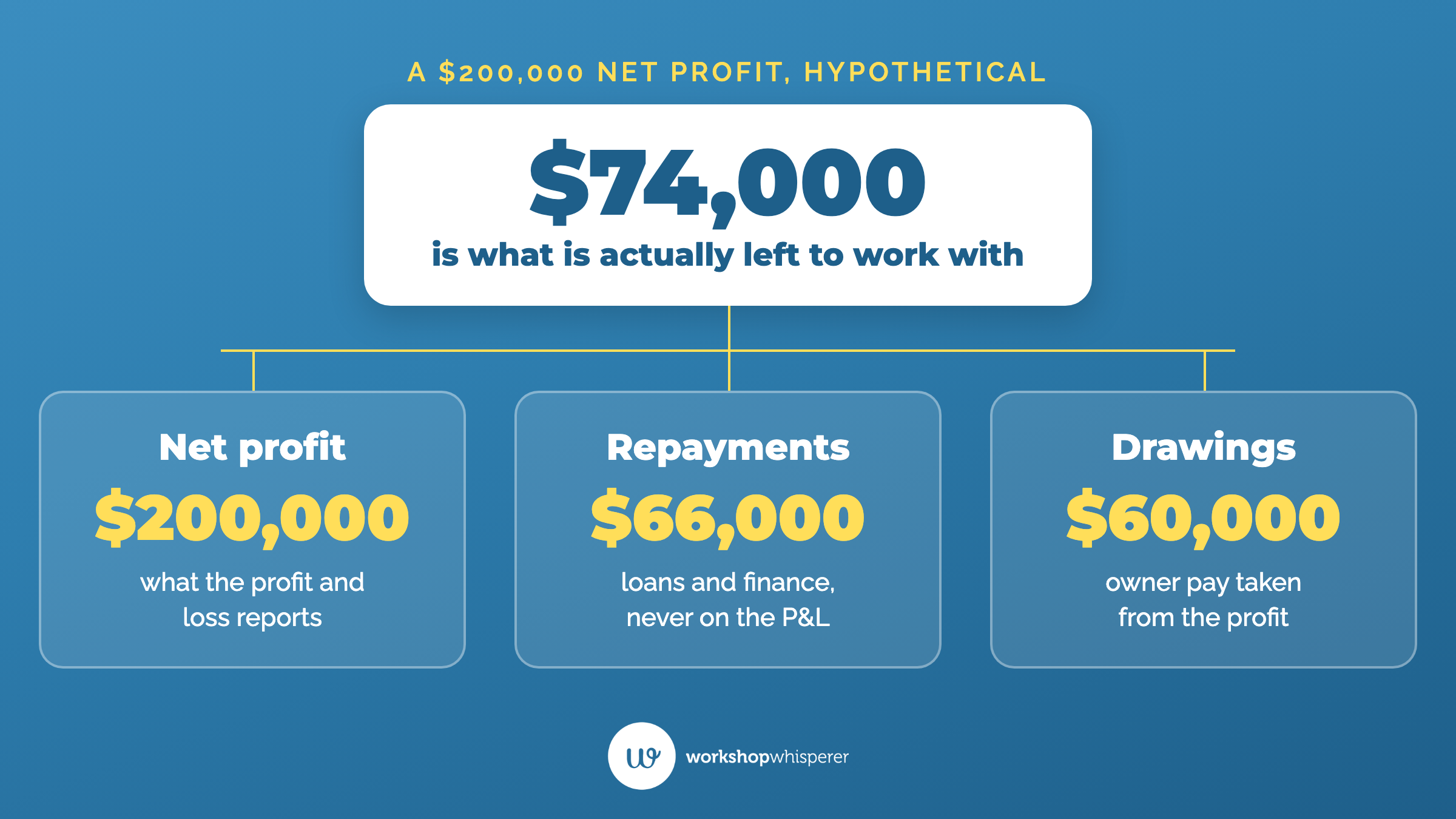
Here is a worked example. The numbers are hypothetical, and the arithmetic is mine.
- Net profit on the report: $200,000
- Equipment finance, business loan and credit card repayments over the year: $66,000
- Drawings taken during the year: $60,000
- What is actually left: $74,000
That is before the tax bill on the profit, which you may not have set aside. A $200,000 result and $74,000 of usable cash is not a mistake. It is the gap between two reports, and almost nobody has been shown both.
Why isn't my accountant explaining this?
Because many accountants do not keep your balance sheet up to date, and one of the most surprising things I have found in this industry is how little attention they pay to it.
I call them beige accountants. If you only speak to yours on a call or a visit once a quarter or once a year, they probably will not go near it. Dean puts a number on how rarely owners look: a shop stuck at six figures often only checks its numbers when it sees the accountant, about four times a year, while a seven-figure shop looks at them every week.
The result is a balance sheet that can be years out of date. A car loan you paid off two years ago can still be sitting there. Equipment finance you cleared can still be listed. You cannot know your true debt position from a document like that, and it is why the whole thing feels written in a different language.
A balance sheet should be accurate at the end of every month, when your books are closed off by you, your bookkeeper or your accountant. In Australia and New Zealand that is the same monthly reconciliation as the GST. If your accounting software is working as it should, you can open it and see where you stand at any time, and the bookkeeping should be done at least weekly.
I have also had clients whose balance sheet was, in my words, a graveyard of old and non-existent debts. It took a year and a change of accountants to clean up, so they could see what they owed and to whom. Within 12 months of using our cash flow management system, they had smashed $300,000 of remaining debt, much of it owed to the ATO.
What does clearing it up actually look like?
It looks like one document and one question.
Ask your bookkeeper to print your balance sheet today. If you do not know how to find it in your software, ask Google or ChatGPT to show you where it is. Then read the liabilities section and look for anything that should not be there, such as the car loan you paid off two years ago, or equipment finance you are sure is cleared.
Then ask your accountant for an updated and accurate balance sheet, with a date. Ask how much you actually owe the tax office right now, and what your repayments are every month. If your accountant is not proactive, and especially if a couple of your last meetings were cancelled, they are not the accountant you need. You have to show up too, with some self responsibility. But a good accountant does not let that go.
Once the debt is visible, you can do something about it. We call any debt without an appreciating asset attached bad debt, and that includes equipment finance. You still need the hoist, and you can claim the tax write off, but it loses value over time, so you pay it down early. We use a technique called a debt snowball to knock off one debt at a time, and it does not involve more debt.
The proof is in the results. One client in Western Australia came to us with $450,000 of ATO debt, poorly managed over time by themselves and previous accountants. With our cash flow management system, they cleared all of it in four years.
Where should the money go instead?
Into separate accounts, so net profit stops disappearing into one pool.
In our cash flow management system an owner moves from one or two bank accounts to five: income, profit, owner's pay, tax and operating expenses. Your customers pay into the income account, where you move the GST out because it was never yours. A percentage goes straight into the profit account before anything else happens. After that comes your pay, then tax, and the operating expenses account holds the money to run the business.
The reason it works is that your shop has a fixed amount to run on. We have written about how this fits together in why isn't my auto repair shop paying me.
Doing this in the Engine Room is one of the first things we help owners put in place. If you are over $50,000 a month and your profit never seems to arrive, this is the work.
Questions auto repair shop owners ask
Why is my net profit high when I have no cash?
Because debt repayments, your own salary and drawings come out of net profit and do not appear on the profit and loss. They live on your balance sheet, so the report can show a good result while the bank account stays empty.
What is a balance sheet?
It is the report that shows what the business owns, what it owes and what is left for you as the owner. Your liabilities, meaning any debt you have to repay, are on it. The repayments never appear on your profit and loss.
How often should my balance sheet be updated?
At the end of every month, when your books are closed off. If yours is years out of date, ask your accountant why.
Is equipment finance good debt or bad debt?
We call it bad debt because the equipment loses value over time, even though you need it to do the work and can claim a tax write off. We do not stop the business functioning to pay it off. We pay it down on a plan.
What if I do not understand my financial reports?
That is normal, and it takes practice. Make a financial appointment with yourself every week. Find one thing you do not understand and ask about it, even if you think it is a silly question. Ask your accountant, or ask in our free Facebook group.
What to do tonight
Find your most recent profit and loss. Look at the net profit line on its own and write the number on a piece of paper.
Then write underneath it what you think you have repaid on debt and taken as drawings over the same period. If you cannot fill in those two numbers, that is the answer to your question.
Tomorrow, ask for the balance sheet, and book a weekly time with yourself to read your financial reports. My best advice is to be more comfortable being uncomfortable with your finances.
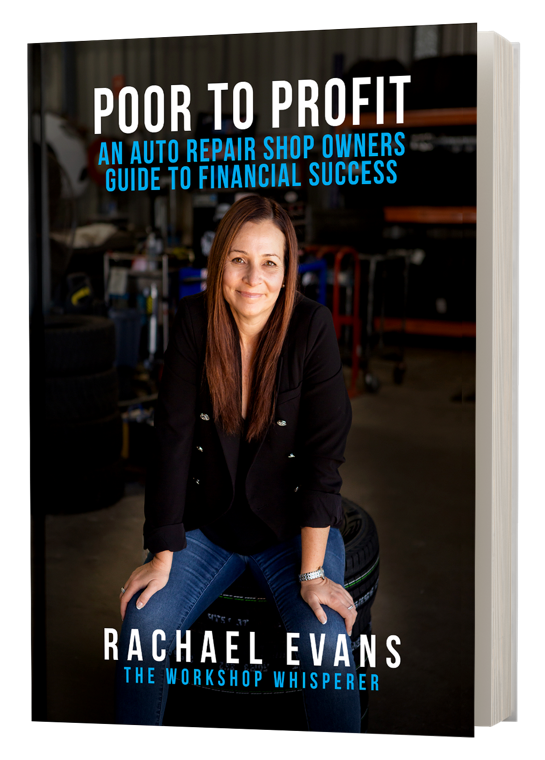
If your numbers have never made sense, our free Poor to Profit ebook is a good place to start. Get your copy here.
Where to go next
- What reports should I pull from my workshop management system
- How Megan and Adam cleared $80,000 of ATO debt in a year
Our clients are named auto repair shop owners, from automotive workshops and garages across five countries, on camera, telling you what changed.
More on this topic: all Money & Profit articles.
Whenever you're ready, here's how we can help.
- Free. Shop Talk, a 30 day reset for auto repair shop owners, and our free resources.
- Under $50,000 a month? Auto Superstars Academy, $997 one off, and Superstar Service Advisor at $197 if the front counter is where your money leaks.
- Over $50,000 a month? The Engine Room, where we put the cash flow management system in place, with one on one coaching on demand from a business coach who is a current or former auto repair shop owner.