
What Should My Operating Expenses Be?
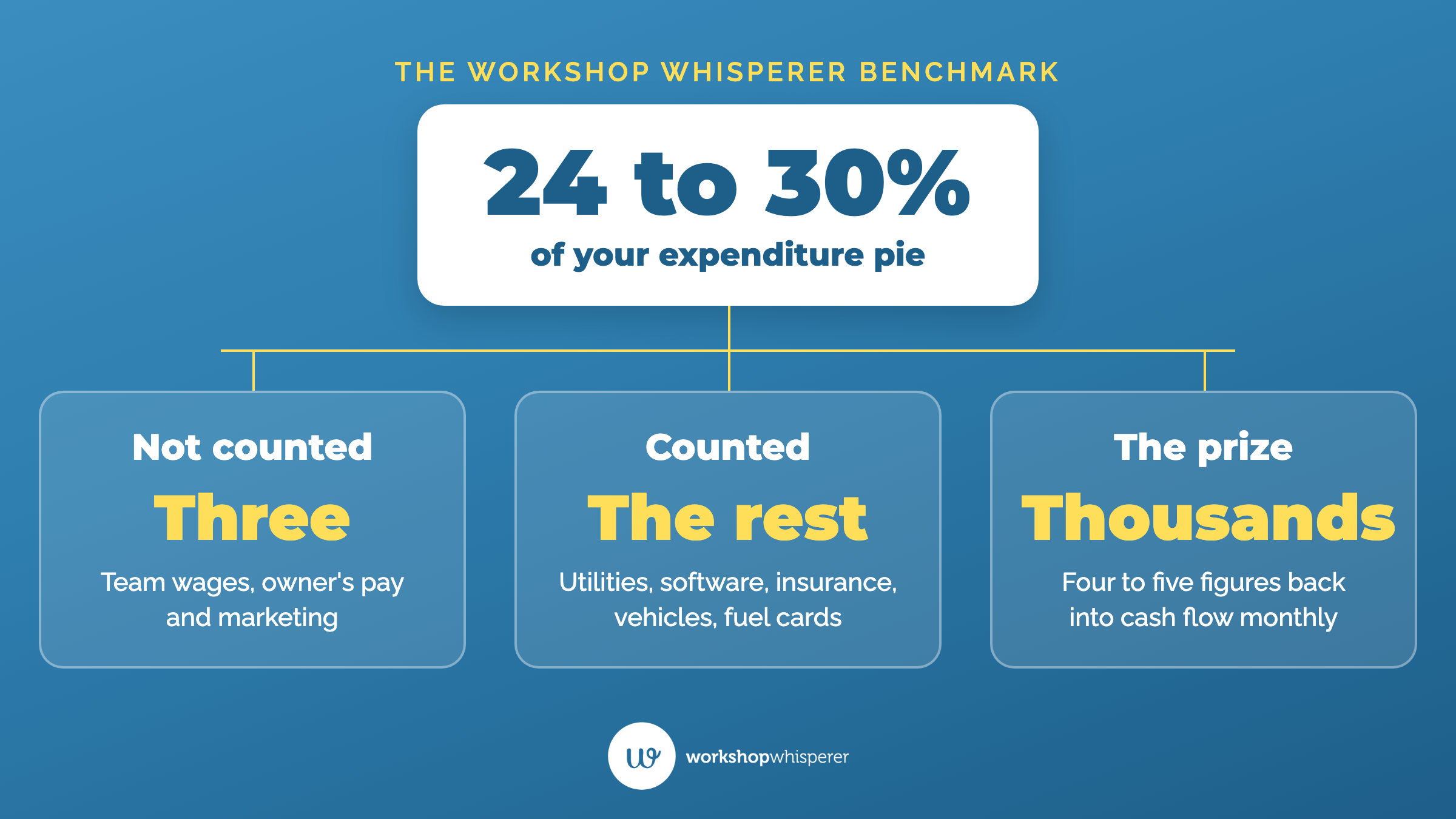
Between 24 and 30% of your expenditure pie. That is the Workshop Whisperer benchmark, and it is one of the few numbers in your business you can check this afternoon.
What matters as much as the number is what sits inside it, because most owners count the wrong things and conclude they are fine.
What counts, and what does not
Not in it: team wages. Not in it: your own pay. Not in it: marketing. Each of those has its own benchmark, and lumping them together is how the figure stops meaning anything.
In it: the things you pay to be in the workshop and do the job. Utilities, phone, water, electricity. Your workshop management software. Motor vehicle expenses, insurance, fuel. The other insurances you are obliged to carry, and the building policy if you own the place. Fuel cards for team members. Phone bills for team members.
That is your operating expenses, and against the whole pie it wants to be 24 to 30%.
Why yours probably drifted
There is a pattern here, and almost every mechanics workshop went through it together.
During the pandemic everybody's expenses had to go on a diet, because the income simply was not there to fund what in a lot of cases was genuine excess. We had all got complacent about money going out the door. Owners who came to us then went through a three stage process for culling, almost like three fallback lines, down to the minimum viable in some cases. It is what got a lot of businesses through.
Owners discovered software they had not used in years and were still paying for. Expenses attached to particular team members that had to go. Old equipment that got sold.
Then the states opened up, the world opened up, and there was a boom. People spent what they had stored up, central banks lifted rates to curb it, and in Australia that meant 13 interest rate rises. Mom and dad drivers felt the pinch and slowed down how often they came back to you.
In between, when the cash was flowing again, we all relaxed about spending. That is the bit nobody notices. The expenses quietly got fat again.
Watch: the full version, including where the benchmark sits in the pie, in about 10 minutes.
Running the number on your own shop
Do this on the back of an invoice before you touch the detail.
Take everything that went out of the business last month. Now set aside the three things that have their own benchmarks: team wages, what you paid yourself, and marketing. What is left is your operating expenses.
Divide that by the total, and you have your percentage.
Say the whole pie came to $100,000 for the month. At benchmark, operating expenses are somewhere between $24,000 and $30,000 of it. At $38,000 you are eight thousand dollars a month above the top of the range, which is close to a hundred thousand dollars across a year, and none of it showed up as a decision anyone made.
Scale that to your own numbers and you will have the size of the gap before you have read a single line of the profit and loss. That figure is what makes the next hour worth sitting through.
The silent part
I have talked through this whole 30 day series about the silent suffering going on in some auto repair shops right now.
Unlike the pandemic, when everybody was visibly in the same boat, it does not look like everyone is in the same boat at the moment. But a great many owners are rowing in the same one without realising it, and this is the leak: expenses that crept back up while the revenue quietly came down.
How to do the review
Get your profit and loss out and go down the operating expenses line by line. For every single item, three questions:
Do I still need this at all? Software nobody opens. Subscriptions attached to someone who left. Services bought for a problem that no longer exists.
Do I need it in the amount I am buying? Plenty of things are necessary at half the volume.
Can I get the same quality for less, still using reputable brands? Not cheaper and worse. Same output, better price.
Anything that cannot be cut outright, consider pausing. If you are not sure whether you need something, stopping it for a period is the fastest way to find out.
The target is worth naming: on most shops this exercise puts at least a high four figure sum, often a five figure sum, back into your cash flow every month, starting the month you do it. Not next year. This month.
Questions owners ask
Is 24 to 30% of revenue or of expenses?
Of your expenditure pie, so the share of what goes out rather than the share of what comes in. That is why wages, owner's pay and marketing sit outside it with their own benchmarks: putting them in makes the number look fine when it is not.
My rent is enormous and I cannot change it. Does that break the benchmark?
Not necessarily, but it does mean everything else has less room. A benchmark is a signal, not a verdict. If one fixed line is dominating, the useful question is what the rest has to look like for the total to work.
I cut everything during covid. Surely there's nothing left?
That is precisely the shops where this finds the most, because the cull happened years ago and the creep since has been invisible. Nobody notices a subscription renewing. They notice twelve of them at once.
How often should I do this?
Once a year properly, at the start of the year, with a quick look each quarter. Expenses do not jump, they drift, which is why an annual line by line is enough to catch it.
What if cutting hurts the shop?
Then do not cut it. This is not about running lean for its own sake. Nothing here should reduce quality, output or how the brand looks. The target is what is genuinely unnecessary, over-purchased, or available at the same standard for less.
The shift
Your operating expenses did not blow out. They drifted, in small amounts, while you were busy, and the drift is invisible until somebody makes you read the list.
This week, print the operating expenses section of your profit and loss, sit down with a pen, and mark every line with keep, reduce, pause or stop. That is the whole exercise. Most automotive workshops find the high four figures a month in the first pass.
If the numbers have never quite made sense to you, start with Poor to Profit. It is free, and it is the financial grounding most owners were never taught.
Want to see shops running to benchmark? Our clients are named auto repair shop owners, and garage owners across five countries, on camera, telling you what changed.
More on this topic: all Money & Profit articles.
Whenever you're ready, here's how we can help.
- Free. Shop Talk, a 30 day reset for auto repair shop owners, and our free resources.
- Under $50,000 a month? Auto Superstars Academy, $997 one off. Your service advisor is where the revenue side of this gets won.
- Over $50,000 a month? The Engine Room, where we run your numbers against every benchmark with you, with one on one coaching on demand from a business coach who is a current or former auto repair shop owner.