What Do I Do About a Talented Technician With a Bad Attitude?
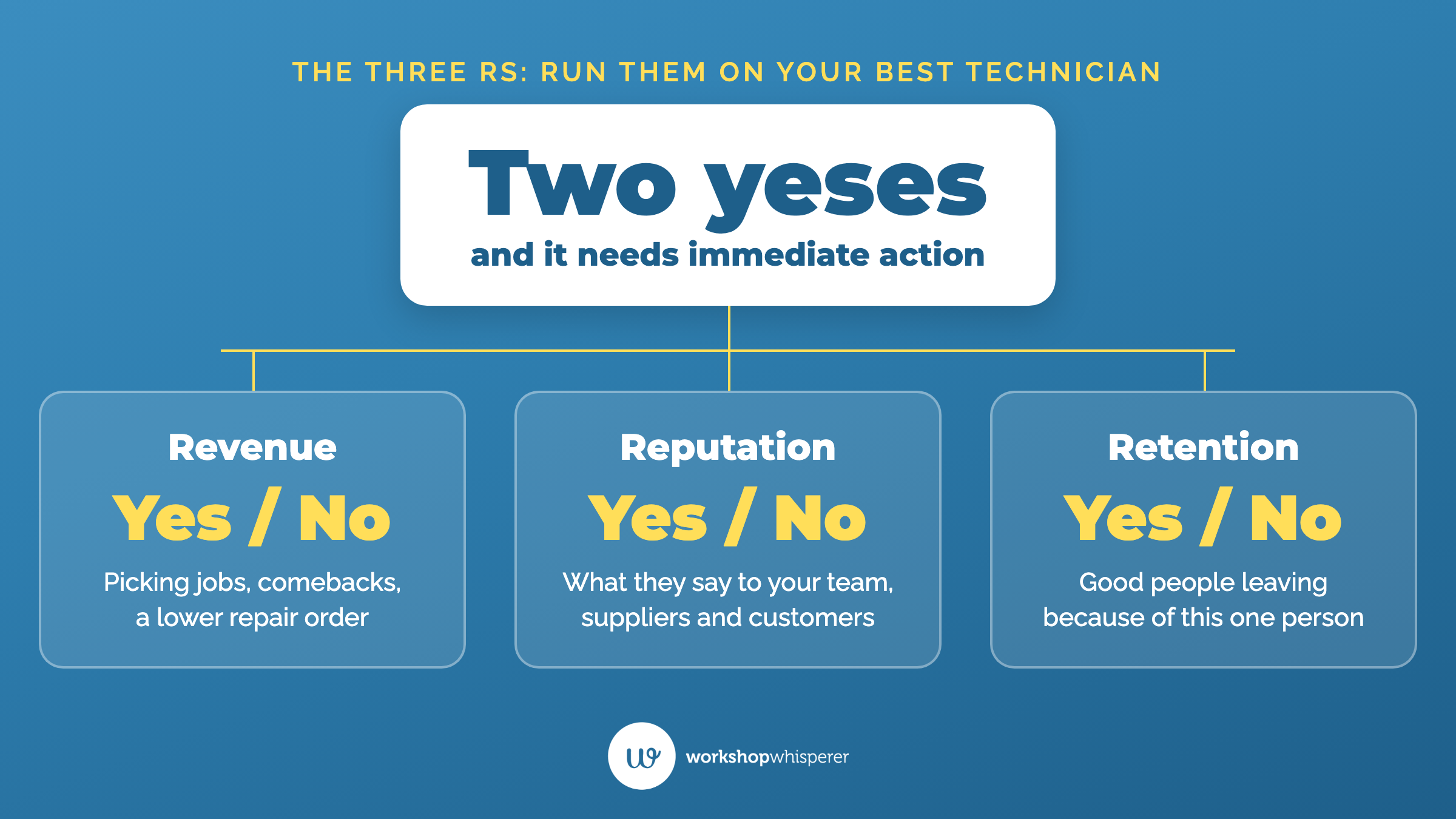
You run three tests on them, and you run them this week. Are they costing you revenue, reputation, or your ability to keep good people? One yes is a conversation. Two is immediate action. Three and they need to go, you simply haven't made it official yet.
That feels harsh about someone who can diagnose anything and who your customers ask for by name. So here is the part most auto repair shop owners have never been told: the decision to protect that person, to keep the peace, is usually the reason your other good people keep leaving.
This is not a staffing problem and it is not a hiring problem. Your best technician might be the most expensive person you employ, and not because of what you pay them.
Why do my good technicians keep leaving?
Because culture is not what you say it is. It is what you tolerate.
I spent four years as a performance coach with the Adelaide 36ers in the NBL, from 2014 to 2018. In that environment you can turn over up to 80% of a playing squad season to season, so you learn quickly what culture does to churn. The same thing happens on the floor of an automotive workshop or a garage, slower and quieter.
Here is the mechanism. Your other technicians watch what the first person gets away with. They see what is tolerated. Then they make a decision, and it is a simple one: either they lower their own standards to match, or they go and find somewhere with better standards.
The ones who care about how work gets done are the ones who leave first. The ones who already dropped their standards stay. And you almost never find out why, because the good ones are too polite to tell you on their way out the door.
Is it one bad apple?
No, and that saying is the reason this gets missed.
A bad apple sits in the barrel and rots. What you actually have is a virus, and a virus does not care how talented the carrier is. It is looking for a host so it can survive.
Picture your best technician. Brilliant hands, fast, customers love the work. They also take long breaks, complain under their breath, are first to say "that's not my job", and give the new apprentice a look when he asks a question. That is the virus, and mostly what it talks about is you.
It finds a host. Say enough of the wrong things for long enough and a second person is carrying it. Now two of them are looking for a third. Then a fourth. Work long enough and the whole team has it, and every one of them needs a new host to survive.
It never shows up on a job card. It does not appear in your average repair order. It costs you far more than you think.
The three Rs
This is the diagnostic we use with our Engine Room and Million Dollar Mechanics Boardroom members. Run it on the person you are thinking about right now.
Revenue. Are they costing you money on jobs? Watch for picking and choosing which parts of a job they will do. Customers asking your service advisor not to put them with that person. Work coming back. A lower average repair order on the days they are on, because they will not recommend the additional work they can see. Revenue damage is the easiest symptom to spot and the easiest to excuse when the person is technically good.
Reputation. What are they saying to your team, your suppliers and your customers? An A-grade technician with a D-grade character does not leave their opinions at the door. They are talkers, and loose lips sink ships. Your business is only as trustworthy as the people who represent it.
Retention. The big one. Are good people leaving because of this one person? Think about the last technician who left and gave you a vague answer about moving on. Be honest: were they moving on, or were they getting away from someone?
One yes is a conversation you need to have. Two yeses is urgent and needs immediate action. Three yeses and the decision is already made.
An A-grade technician who scores on two or three of those is not one of your best employees. They are your biggest liability. This is a test of the quality of the person, not the size of their skill.
Watch: I walk through how culture drives recruitment, productivity and retention in your mechanic workshop, and what four years in professional sport taught me about churn. 13 minutes.
What this cost one shop
One of our Engine Room members lost two good technicians inside twelve months and could not work out what had happened. The pay was good. The conditions were good. There was no obvious reason either of them walked.
When he finally asked the right questions, both exits pointed to the same person.
He had been managing around that individual for years, giving them the good jobs and letting a few things slide he would not have let slide with anybody else. The two people who left were the ones who noticed.
The question you may not want to answer
Before you go categorising the people who work for you, Rachael makes you stop and look somewhere less comfortable first.
Are you an A-player boss, or a B-player boss?
You can be a B-player boss and still be worth plenty. You might be new at this, or learning, or you have reached the top of one mountain and started climbing the next, and the quality of the team around you now demands your leadership goes up a notch. People move in and out of A and B across a career.
The reason it matters here is simple. If you are walking on eggshells around someone in your own shop, that is not their problem to solve. Your shop, your rules, your standards. And if you keep them, you have told your whole team that the standard the carrier works to is the standard you accept.
Three things to do tonight
Ask yourself the gut question. If that person handed in their notice tomorrow, what is your honest first reaction? Dread, or relief? If any part of you would feel relief, you have your answer. Your gut will tell you something a spreadsheet cannot.
Run the three Rs on them. Revenue, yes or no. Reputation, yes or no. Retention, yes or no. Count them.
Look around the floor. Is anyone treading carefully around this person because they are afraid to upset them? If the person treading carefully is you, that is the whole answer.
Questions owners ask
Can I really afford to lose my best technician?
That is the fear, and it is understandable. But in practice, when the carrier leaves, the shop does not fall apart. Owners tell us the same thing every time: the business took a breath, not a hit, and the rest of the team gelled almost immediately. You are not choosing between the work going out and the person going. You are choosing which standard your team works to.
What if they are genuinely brilliant at the job?
Technical skill gets the job done. Character is what keeps a team together. A-grade hands with a D-grade character is not your best technician, it is your biggest risk. You can replace a skill set. Rebuilding a team that has learned to work to a lower standard takes years.
Isn't this just a personality clash?
Run the three Rs and find out. A personality clash shows up in one relationship. A virus shows up in your revenue, in what people say about you outside the shop, and in who resigns. If two or three of those are moving, it is not personal.
How do I stop hiring the same problem again?
By hiring the whole person rather than the skill set. The skills are visible at interview. The virus is not, and you often cannot see it until it is too late. That is the entire reason we built the five questions below.
Do I have to sack them straight away?
No. One yes is a conversation, and plenty of people respond to a clear, direct conversation about the standard, especially if nobody has ever had it with them. What you cannot do is wait and hope, because every week you tolerate it, the rest of the team is learning what is acceptable here.
The shift
Technical skill gets the job done. Character keeps the team together. Remove the virus and the team gets healthier almost on its own, because there is a real difference between respecting someone in your workplace and feeling held hostage by them.
The goal is not simply to move this person on. It is to stop creating the conditions that let it spread in the first place, which starts at the next person you hire.
Grab 5 Smart Questions to Ask Before You Hire. It walks you through hiring the whole person, not the skill set.
Fixing the whole team rather than one person is what our Ultimate Team Advantage program is built for. And if you want to see what the other side looks like, our clients are named auto repair shop owners, on camera, saying what changed.
More on this topic: all Culture & Meaning articles.
Whenever you're ready, here's how we can help.
- Free. Shop Talk, a 30 day reset for auto repair shop owners, and our free resources.
- Under $50,000 a month? Auto Superstars Academy, $997 one off.
- Over $50,000 a month? The Engine Room, with one on one coaching on demand from a business coach who is a current or former auto repair shop owner, and who has had this exact conversation in their own shop.