I'm a Mechanic, Not a Businessman. How Jeff Stopped the Slide
You stop it by finding out what an hour actually costs you to run, then pricing from that instead of from a feeling. Jeff Hazzledine of SCS Four Wheel Drive Centre in Mordialloc reckons he had paid for the course by week four, on nothing more than that.
He had already sold his house by then.
How bad it got
Jeff does not soften it:
"We were going rapidly downhill. Had to sell our house to support our business and we thought that we were going to lose everything."
The business was, in his words, "going backward rapidly with not knowing how to deal with creditors and quoting".
And underneath that, the thing almost every auto repair shop owner will recognise:
"Had no budgets, no structures. Had no idea what a profit and loss sheet looked like. We just saw money in the account and thought we had money so we would spend it."
Money in the account is not profit. It is just money that has not left yet. Nobody ever told Jeff that, because nobody tells any of us that during an apprenticeship.
What changed, and how fast
Not a transformation. Small implementations, from week one.
"I think I'd already paid for the course by week four with just some little implementations like knowing how to mark your parts up and your labor rates and what my break even rates were."
And the one that reframes everything:
"What it actually cost me an hour to run my workshop compared to what I thought it cost me."
Compared to what I thought it cost me. Most owners are carrying a number in their head that was never calculated, and every quote they give is built on it.
Then came the structural things: budgets, structures, and reading a profit and loss properly. None of it is specific to a four wheel drive centre; it is the same arithmetic in any automotive workshop or garage.
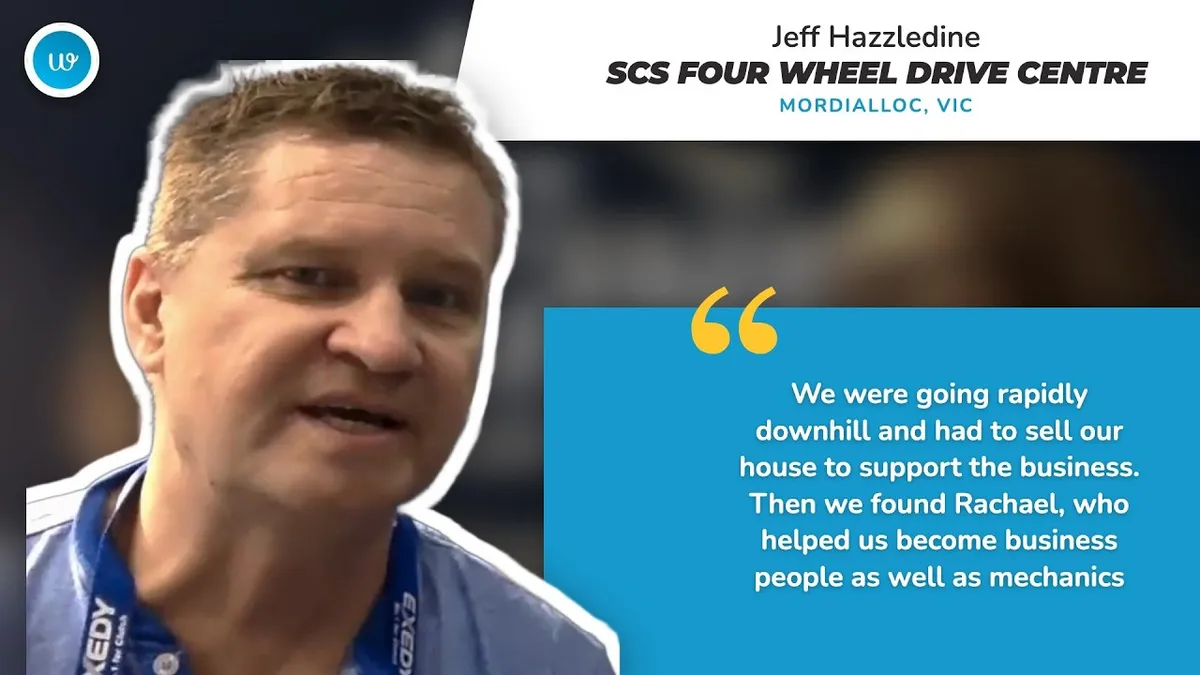
Watch: Jeff tells it himself in under three minutes.
The part that keeps it going
Jeff names something that has nothing to do with numbers, and it is why the change held.
When he slips, other owners in the group pull him up:
"People go, 'Hang on a sec. Why aren't you doing this, this, and this like you've always done?'"
An owner on their own has nobody to do that. A plan with nobody holding you to it is a wish list you wrote on a good day.
Where Jeff is now
Learning "the nuts and bolts of the business" was, in his words, "a life changer for us". He credits the work with helping them "become business people as well as mechanics."
That is the whole shift in one line. He was always a good mechanic. The business needed something else from him, and nobody had ever shown him what.
Why so many owners fund the business from their own pocket
Jeff is not unusual. Owners put houses, savings and borrowings into shops every year, and it is rarely because the business has no customers.
It is because of the thing he named: seeing money in the account and believing it is yours.
The bank balance is the most misleading number in a mechanics workshop. It holds money that belongs to the tax office, money that belongs to suppliers, and money already committed to wages. An owner reading it as available will spend into commitments they have not counted yet, and the shortfall appears later as something personal money has to cover.
Underneath that is the pricing. If the labour rate was never calculated against what an hour costs to produce, every busy week makes the problem worse rather than better, because volume multiplies a loss as efficiently as it multiplies a profit.
Put those together and you get an owner working harder, selling more, and funding the gap from home. The business looks like it needs more effort. What it needs is a different price and a different way of reading the money.
That is why Jeff's four weeks were enough to change things. He did not work harder. He found out what an hour cost and charged accordingly.
Which part of this sounds like your shop?
If you have ever looked at the bank balance and decided you could afford something, that is the before.
If you could not say, to the dollar, what one hour of workshop time costs you to produce, that is the gap Jeff closed in week four.
If you have put personal money or personal property into the business to keep it alive, you are further down the same road he was on, and it is worth acting now rather than later.
Questions auto repair shop owners ask
What is a break-even rate and why does it matter more than my labour rate?
It is what one hour costs you to produce, before any profit. Your labour rate has to clear it or every hour you sell loses money. Most owners have never calculated it, which is why their rate feels arbitrary.
How do I work out what an hour really costs me?
Total your fixed costs and your wage costs for a period, then divide by the hours you can actually sell in that period. The answer is usually higher than people expect, and that gap is the whole lesson.
I'm not good with numbers. Is this realistic for me?
Jeff says plainly he had no idea what a profit and loss sheet looked like. The skill is learnable and the first useful piece of it took him four weeks.
I've already put my own money in. Is it too late?
It was not for Jeff, and he had sold the house. The question is whether the pricing changes, because putting more money into a business that prices below cost just funds the same loss for longer.
Do I have to do this with other people?
You do not have to. But Jeff credits the group with catching him when he drifts, and that is the part solo owners most often lose.
What to do tonight
Work out one number: what one sellable hour costs you to produce.
Add up last month's fixed costs plus the wages of everyone who turns a spanner. Divide by the hours you actually billed. Compare it to your labour rate.
If those two numbers are close, you have found the problem without anyone's help. Our free break-even calculator will do the arithmetic.
Jeff is one of many. Our clients are named auto repair shop owners, and garage owners across five countries, on camera, telling you what changed.
Where to go next
- How to work out what your labour rate should be
- How to markup or margin on parts
- How to why you're busy but not making any money
- How to the numbers to check every week
- How to hold your team accountable without micromanaging
More on this topic: all Money & Profit articles.
Whenever you're ready, here's how we can help.
- Free. Shop Talk, a 30 day reset for auto repair shop owners, and our free resources.
- Under $50,000 a month? Auto Superstars Academy, $997 one off. Your service advisor is who holds the rate at the counter.
- Over $50,000 a month? The Engine Room, where Jeff learned this, with one on one coaching on demand from a business coach who is a current or former auto repair shop owner.