
How Do I Work With My Partner in the Business?
You agree on the rules before you need them, and the first rule is that there can only be one CEO.
That sounds blunt for a marriage. It is also the single thing that stops most of the damage, because without a tiebreaker every disagreement stays open and your team never knows whose instruction counts.
Almost every independent mechanics workshop, automotive workshop or garage has a technician owner. Call it 99%. A great many also have that owner's life partner involved somehow. We have been doing this for twelve years, mostly with couples in business, and here is what we know: whatever is happening in your relationship shows up in your financial results, your culture and the quality of life you get out of the thing, whether or not anybody mentions it at work.
How it usually goes wrong
Nobody plans this. It is an accident, and it follows the same path almost every time.
The technician owner wants to go into business. Their partner supports it without intending to work there day to day. Then the stress builds, and the partner comes in to relieve it.
Once in, she usually takes the financial burden on herself, because that is the part visibly crushing him. She works out the numbers, pays the bills, chases anything overdue. She wants him to have the best quality life he can.
And by taking it on, she disempowers both of you.
You know it has happened when you start arguing about money. She becomes as stressed as he is, because there is not enough coming through, and now she is the one robbing Peter to pay Paul while thinking she is freeing him to sell hours and get cars out. He is still stressed because there are no proper systems. She is stressed because the money will not stretch.
Now two people are tied to the business, two people cannot get free of it, and it would be a minor miracle if the team had not picked up on the atmosphere.
Dean puts the fear plainly: what every couple dreads is ending up at each other's throats. What they actually want is to be side by side, backing each other, heading the same way. He and I have had to work at exactly that, as a married couple running this business together.
Watch: the full version, including why your team goes quiet when the two of you override each other, in about 15 minutes.
The agreements
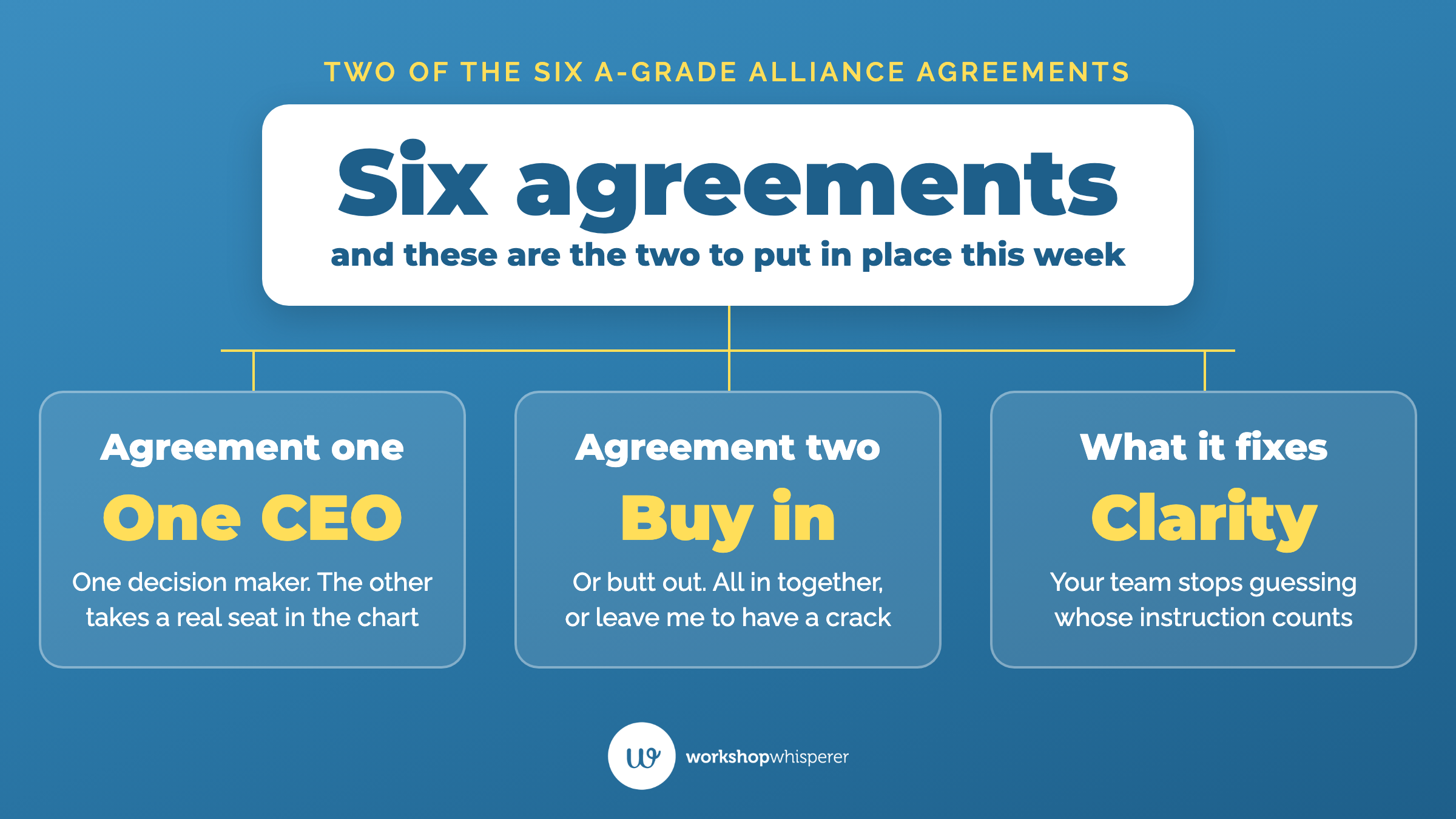
Inside our Engine Room program we teach this as the A-Grade Alliance, a set of six agreements a partnership operates by. There is a shorter version on our YouTube channel. Two of the six matter most, and they are the two I would put in place this week.
One: there can only be one CEO
Whether you are a couple or two technician mates or any other pairing, somebody has to be the ultimate decision maker. Not because the other person counts for less, but because you need a tiebreaker for the times you genuinely disagree.
Think about the biggest companies in the world. Co-CEOs are vanishingly rare. Atlassian ran that way for a while and does not now. Google did for a time. Almost everybody else has one, for exactly this reason.
In our client base the CEO is often the partner who came in later, because they have ended up more focused on building the business while the technician owner is still overseeing the floor, selling hours and sometimes working the service desk too.
There is no right answer about which of you it is. There only has to be one. And once it is decided, you both honour it. If you are the technician owner and it makes more sense for your partner to be CEO, you back that completely, and you never undermine it in front of the team.
The other person takes a real seat in the org chart, usually operations manager or managing director, overseeing the team, with instruction flowing from the CEO down. That is not a demotion, it is a chain of command.
Here is why this matters more than it sounds. When the two of you override each other, your team has no idea who to take instruction from. It is completely confusing, and it will put an A-player off working for you. The chain of command being unclear is enough on its own to lose good people.
Two: buy in or butt out
This one bites when the technician owner is in the business full time and the partner drifts in and out.
The partner becomes the handbrake on growth, sometimes out of their own fear, sometimes because they do not fully trust the decisions being made. They weigh in when uncomfortable, without being there day to day carrying a fair share.
So the agreement is: buy in or butt out. Either we are in this together, or you leave me to have a full crack at it. What cannot continue is commentary from the sideline every time something feels risky.
It can be said far more gently than that, and it should be. But that is the substance, and the sentence is memorable for a reason.
Questions owners ask
We've never had these conversations. Where do we start?
With the CEO question, away from the shop, when neither of you is tired. It is one decision and the rest get easier once it is made. Everything else is easier to agree once you both know who breaks a tie.
What if we can't agree who the CEO should be?
Ask who is already making most of the operational and financial decisions, and who is most often on the tools or at the counter. The answer is usually obvious once it is framed as a job rather than a ranking.
Doesn't one CEO mean one person gets their way?
No. It means one person decides when you cannot agree, which is rarer than you think. It is not a licence to become autocratic, and a CEO who starts issuing orders has misread it. Most decisions still get made together.
My partner isn't in the business at all. Does this still apply?
Parts of it. You are still both relying on the business for your income and your life, so what happens at work lands at home either way. The buy-in-or-butt-out agreement is often the relevant one, in reverse.
Where do I find the other four agreements?
Search "alliance" on our YouTube channel for the mini training. The in-depth version sits inside the Engine Room, where we work through all six with you.
The shift
You were life partners before you were business partners, and you owe the first relationship the same ground rules you would give any serious commercial one.
Tonight, over dinner and away from the shop, answer one question between you: who is the CEO? Do not solve anything else. Just agree the tiebreaker, and agree that whoever it is gets backed in front of the team from tomorrow.
If you want to compare notes with other owners in the same position, we run a free Facebook group called Your Profitable Auto Repair Shop. Come and join us.
Want to see couples who got this right? Our clients are named auto repair shop owners, many of them couples, on camera, telling you what changed.
More on this topic: all Culture & Meaning articles.
Whenever you're ready, here's how we can help.
- Free. Shop Talk, a 30 day reset for auto repair shop owners, and our free resources.
- Under $50,000 a month? Auto Superstars Academy, $997 one off. Your service advisor, service writer or service adviser is often where the pressure lands first.
- Over $50,000 a month? The Engine Room, where the A-Grade Alliance is taught in full, with one on one coaching on demand from a business coach who is a current or former auto repair shop owner.