

Why Am I Afraid to Hold My Technicians to the Time Clock?
Because you think that if you push, the technician will leave, and in this market a good one is hard to replace. That fear is understandable, and it is costing you money every day the time clock sits there switched on, or off, and nobody is held to it.
The way through is not a confrontation. It is a standard that applies to everyone, including you, followed through every day.
I'll show you why the fear is so common in a mechanics workshop, what it is worth in dollars, and how to start this week without losing anyone you want to keep.
Why do owners avoid holding technicians to the clock?
There are two fears, and they feed each other.
The first is the labour market. Across Australia, New Zealand and the US the shortage works out at roughly one technician short for every auto repair shop. So when a technician is slower than the book time, or refuses to clock on and off properly, you tell yourself you cannot afford the argument. You put up with a result that is below standard, and from that moment you are losing money.
The second fear is time. You are too busy working in the business to open the report your software is already producing. So you do not look at it, and you do not know what is going on in the 38 hours a week you are paying for.
Then the technician says what technicians say. "It's like big brother." "Why don't you trust us?" Anything that throws you off doing what you are entitled to do as the owner. It works, because you are already afraid.
Here is how I put it in the video, and I mean it kindly:
"If you don't call them out and hold them accountable to that system that you've put in place, then that's on you. That's your poor leadership. That's costing you money."
Your technicians are not the problem in that sentence. They work for you because they do not own a business. You carry the risk, you pay for the equipment, and you finance the whole operation. Knowing where the 38 hours went is your right as the owner, and it is exactly what a dealership would expect.
Watch: about 23 minutes, and I stay on the fear and the time clock the whole way through, with the numbers.
What is a few minutes on the clock actually worth?
More than it sounds like, because of how a repair shop's costs work.
You have already paid the wages, the rent and the power for that job. So every extra minute you bill on it goes straight to the bottom line. I put it this way in the video: "Extra dollars collected through labor is pure profit."
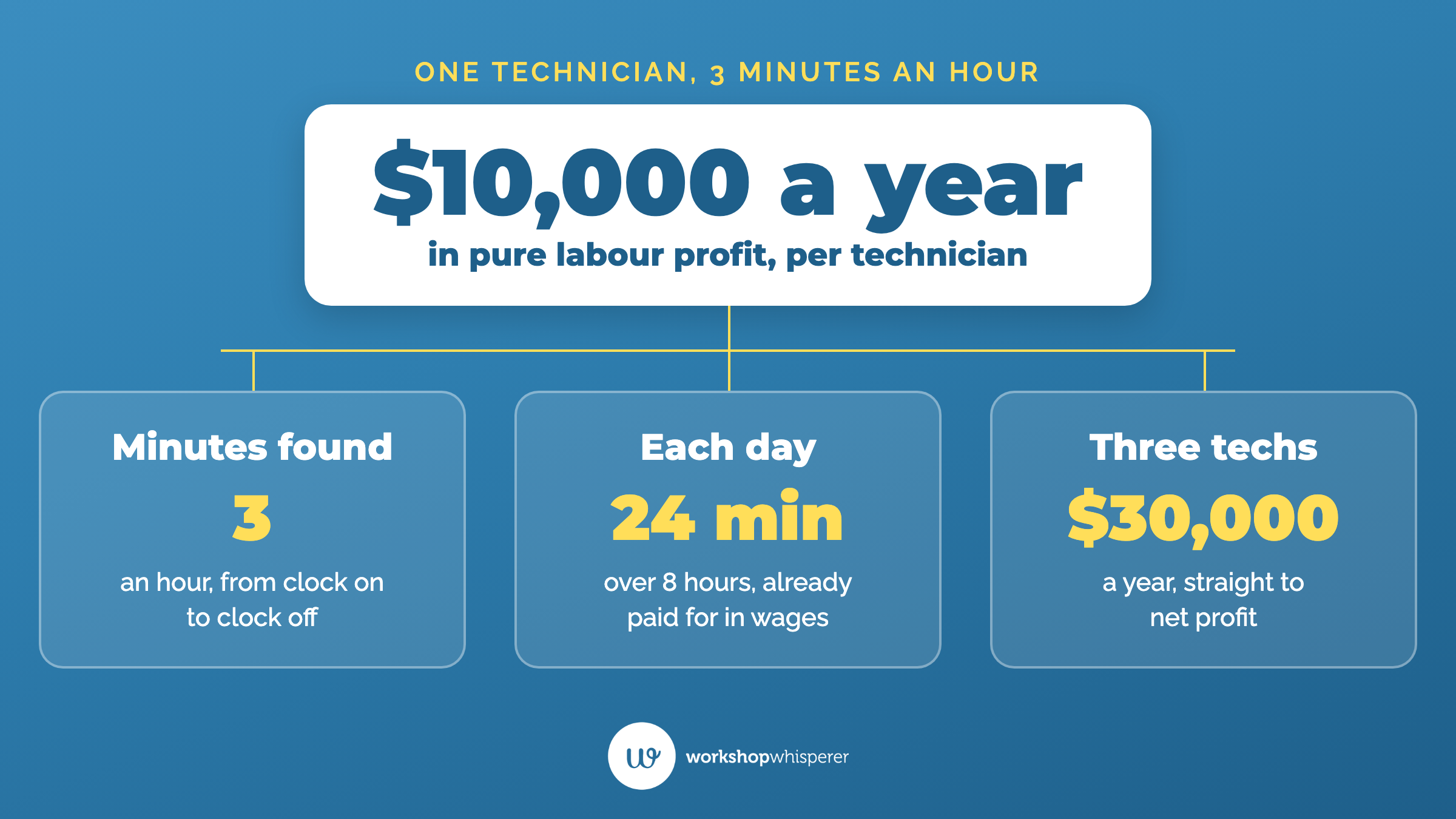
My benchmark is 3 extra minutes billed for every hour a technician is at work. Over an 8 hour day that is 24 minutes.
Here is the arithmetic. Say your labour rate is $110 an hour. 24 minutes is 0.4 of an hour, which is $44. Across about 230 working days, once public holidays and annual leave are out, that comes to $10,120. That is my own sum, and it lands where the figure I have used for years does: about $10,000 a year in pure labour profit, per technician.
Now multiply it by your team.
- Three technicians: $30,000 a year.
- Seven technicians: $70,000 a year.
If you are carrying a cash flow problem, that is the difference between a month you dread and a month you do not. And you have not touched your labour rate to get it. You have only captured time you were already paying for.
Where does the time go? At the start and end of a job, mostly. From the moment the technician picks up the keys and the job card to the moment they hand them back to the service writer, those few minutes feel unimportant. They are not.
Here is what happens when nobody tracks it. I said it in a video back in 2020: when we guess, we always round down. It is human nature. Guess what time you started, and you lose minutes on either side of the job.
How big is the gap in a shop that does not clock properly?
Dean put a number on it in his episode on team productivity.
The average auto repair shop across Australia and New Zealand sits at 62% productivity. That means 38% of every workday goes unaccounted for. In a 10 hour day it is nearly 4 hours per technician, time you pay wages for and never bill. A shop that is solidly profitable runs at about 85%, with every technician clocking on and off every job, every time.
The difference between those two shops is not the team. It is that one of them can see.
Dean asked one of our Engine Room members, who was sure his team was flat out, to try one thing. For one week, get every technician to write down what they did in 15 minute blocks. Pen and paper, nothing fancy. Across his three technicians he was losing about 22 billable hours a week. He had been about to hire a fourth technician, and he did not need to. He needed to stop the leak in the three he had.
Dean's line for it stays with me: busy is the disguise unproductive time wears.
Why does my team stop clocking properly after a few weeks?
Because they are watching you, and I have seen it more times than I can count.
You put the system in. You train the team. Then it does not stick, and the reason is not your intentions. You got busy, your team noticed, and they went back to how they did it before.
This is the part of leadership most owners find hardest. If you have time clocking, you time clock 100%. You do not enforce it for some things and not others. You do not keep wiping time off because a technician forgot. You do what you said you would do, and you follow through.
How we do one thing is how we do everything. If the standard bends on the clock, your team will expect it to bend everywhere else.
How do I start without losing a good technician?
Keep it small, and keep it the same for everyone.
- Turn it on, or go and look at it. If your workshop management software has continuous time clocking, make sure it is running on every job. If it does not, a pen and a job card will do for a week, as Dean's member found.
- Set the standard out loud. Hold a toolbox meeting and tell the team the goal: an extra 24 minutes per technician per day, from a proper clock on and clock off, and from catching the extra work they see while they are already under the car.
- Review it on a schedule. Daily or at the end of the day, whichever suits your shop. A technician who ran over book time hears about it then and there, not three weeks later.
- Hold the standard when it is awkward. The first time someone pushes back, you find out whether the system is real.
I will be honest about the person who flatly refuses. It is a scary thing to do in a labour market where good people are hard to find. But a technician who will not be transparent about 38 paid hours a week is likely to be doing the same thing somewhere else too.
Questions auto repair shop owners ask
What if my technician says it's big brother?
Say it plainly: you pay for 38 hours and you want to see where they go. The clock protects good technicians as well, because it shows who is carrying the load. Then ask for what you asked of everyone, which is a proper clock on and clock off.
Do I need new software for this?
If your current system does not clock continuously, or you cannot see the report, it is worth a demo. In Australia and New Zealand you want software that connects to your accounting program. Until then, a pen and a job card will show you the gap.
Will my technicians quit if I enforce it?
Some owners fear exactly that, and it can happen. What I can tell you is that a standard applied fairly, explained clearly, and followed through by the owner is a very different thing to a surprise.
What if I'm an owner technician and clock myself?
The standard starts with you. If you do it some days and not others, so will they.
What if we already time clock but our productivity is low?
Then the clock is working and the follow-through is not. Look at the daily number, share it with the team, and ask what is getting in the way. Admin, cleaning and chasing parts during the job are the usual leaks.
What to do tonight
Open the time clocking report for last week, or if you have none, decide who will write times on job cards tomorrow.
Then look at one technician's 38 hours and ask where they went. You do not have to say anything to anyone yet. You only need to know.
Put a toolbox meeting in the diary for this week and tell the team about the 24 minute goal. A standard that is announced and then never checked is the same as no standard.
If you would like to compare notes with owners working on the same thing, we run a free Facebook group called Your Profitable Auto Repair Shop. Come and join us.
Where to go next
- How many billable hours should a technician produce
- How to hold your team accountable without micromanaging
- What to look for in workshop management software
Our clients are named auto repair shop owners, from automotive workshops and garages across five countries, on camera, telling you what changed.
More on this topic: all Productivity articles.
Whenever you're ready, here's how we can help.
- Free. Shop Talk, a 30 day reset for auto repair shop owners, and our free resources.
- Under $50,000 a month? Auto Superstars Academy, $997 one off, and Superstar Service Advisor at $197 if the front counter is where your time gets lost.
- Over $50,000 a month? The Engine Room, where we help owners put this in place, with one on one coaching on demand from a business coach who is a current or former auto repair shop owner.