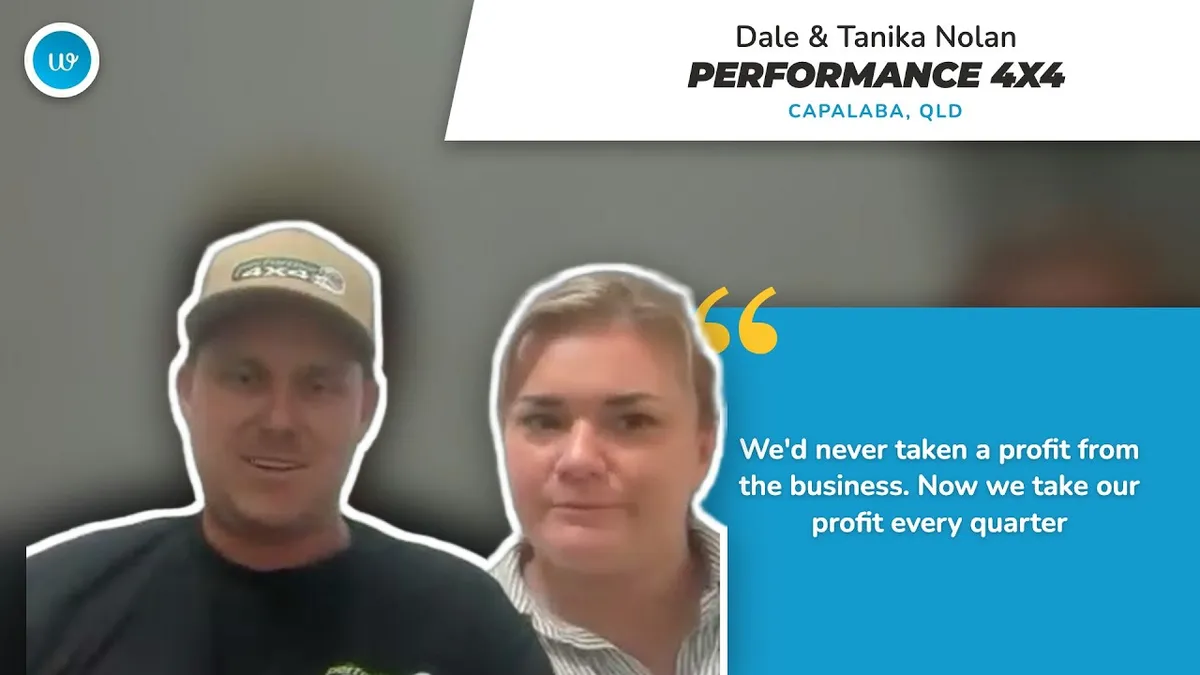
We've Never Taken a Profit. How Dale and Tanika Changed That
Their first ever dividend from Performance 4x4 was sixty dollars.
That is not a typo and it is not a sad detail. It is the moment a business stopped being something they fed and started being something that paid them. They now take quarterly profits, every quarter.
If you have never drawn a profit from your own mechanics workshop, you are in a larger group than you think, and the first distribution being small is completely normal. It is true of automotive workshops of every size, including ones turning over seven figures.
What a week looked like before
Dale describes it as chaotic, and the detail is the part owners recognise:
"We'd walk around the shop and we're like, 'All right, let's prioritize. Which one's worth the most? Like let's get this out because we need it out.'"
Triaging by value, because the cash had to come from somewhere today. Always tripping over yourself, always short of time.
And then the thing that sits underneath almost every shop in this position:
"I wouldn't worry about money. I refused to look at it."
That is not laziness. Looking costs something when you suspect the answer, so not looking feels like protection. It is the most expensive avoidance in small business.
Why not looking makes it worse
A number you refuse to read does not stop existing. It compounds while you are not watching.
Worse, it removes every option you might have had. An owner who knows the month is short can change the mix of work, chase declined jobs, move a price or have a conversation with the bank. An owner who does not know has none of those, because you cannot act on information you have refused to collect.
It also guarantees the chaos. Triaging by invoice value, deciding each morning which car matters most because the cash is needed today, is what running without numbers looks like on the floor. The disorganisation is a symptom. The cause is upstream.
Tanika's line is the whole reversal, and it is worth reading twice:
"Better off knowing you're in a bad spot than not knowing if you're in a bad spot or how bad it is."
Watch: Dale and Tanika tell it themselves in under three minutes.
What they changed
Systems their A-grade player could actually use and rely on. Not systems in the owner's head. Ones a senior team member could run from.
Knowing exactly where they stand financially, in Tanika's words, even when the answer is not a good one.
A game plan with a real target, which for them was three million.
Taking quarterly profits deliberately, rather than hoping something was left.
Tanika stepped into the CEO role. She built the confidence for it partly from seeing other women leading shops inside the program, and she did some unglamorous things that made it possible: got a cleaner, and took Monday night pottery. Protecting a night that is yours is not indulgence, it is what stops the business taking all of them.
And they stopped believing they were a special case. Their coach repeated one phrase until it landed: you're not different. Nearly every owner thinks their shop is the exception that coaching will not fit. It almost never is.
Where Performance 4x4 is now
They set out to hit three million and came in just under. In their own words, "we didn't quite hit the 3 mil. I think we hit 2.97 or something."
They take quarterly profits, every quarter, from a business that had never paid them one.
And the measure that tells you the systems are real: the check-ins now run every day or two, and about 90% of them have nothing to report. A shop with nothing to report is a shop that is running.
Which part of this sounds like your shop?
If you decide each morning which job gets finished based on what it is worth, you are triaging cash rather than managing work.
If you avoid opening the accounts, that is the single most common and most costly habit in this industry.
If you have never taken a dividend, the fix is not a bigger year. It is a deliberate decision to take one, starting small.
Questions auto repair shop owners ask
A sixty dollar dividend sounds pointless. Why bother?
Because it establishes that profit is something the business pays out rather than something that might be left over. The size follows. The habit is the hard part.
I genuinely do not want to look at the numbers.
That is extremely common, and the reason is almost always fear of what they say. Knowing is uncomfortable for a week and useful forever. Not knowing is comfortable right up until it is not.
My shop really is different, though.
Most owners say that, and it is almost always about the make mix, the town, or the customer base. None of those change what an hour costs to produce or whether the business pays you.
What does a CEO actually do in a workshop this size?
Decides. Sets the direction, holds the plan, and breaks the tie. In a couple-run business it also means one of you is clearly the one who decides, which removes a great deal of friction.
How long until this works?
They were working to an annual target, so a year rather than a quarter. The first dividend came long before the three million did, which is the useful part: the habit of paying yourself starts years ahead of the number that makes it comfortable.
What to do tonight
Open your accounts. Do not fix anything, do not plan anything, just look, and write down two numbers: what is in there, and what you owe.
That is it. The looking is the hard part, and everything Dale and Tanika did came after it.
Then, before the end of this quarter, pay yourself a dividend. Any amount. Sixty dollars is a perfectly good place to start, and it is more than most owners have ever taken.
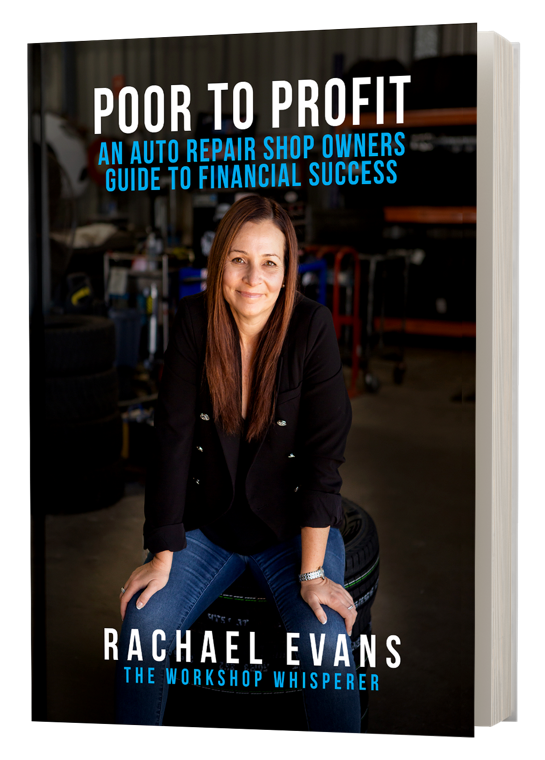
If the numbers have never made sense to you, start with Poor to Profit. It is free, and it was written for exactly this.
Where to go next
- Why isn't my auto repair shop paying me?
- How to fix cash flow in your auto repair shop
- The numbers to check every week
- Is business coaching worth it for an auto repair shop?
- How to build a shop that runs without you
Our clients are named auto repair shop owners, and garage owners across five countries, on camera, telling you what changed. Thirteen years, more than 10,000 shops, and over $175 million in additional profits generated.
More on this topic: all Money & Profit articles.
Whenever you're ready, here's how we can help.
- Free. Shop Talk, a 30 day reset for auto repair shop owners, and our free resources.
- Under $50,000 a month? Auto Superstars Academy, $997 one off. Your service advisor is where the day stops being triage.
- Over $50,000 a month? The Engine Room, where Dale and Tanika did this, with one on one coaching on demand from a business coach who is a current or former auto repair shop owner.