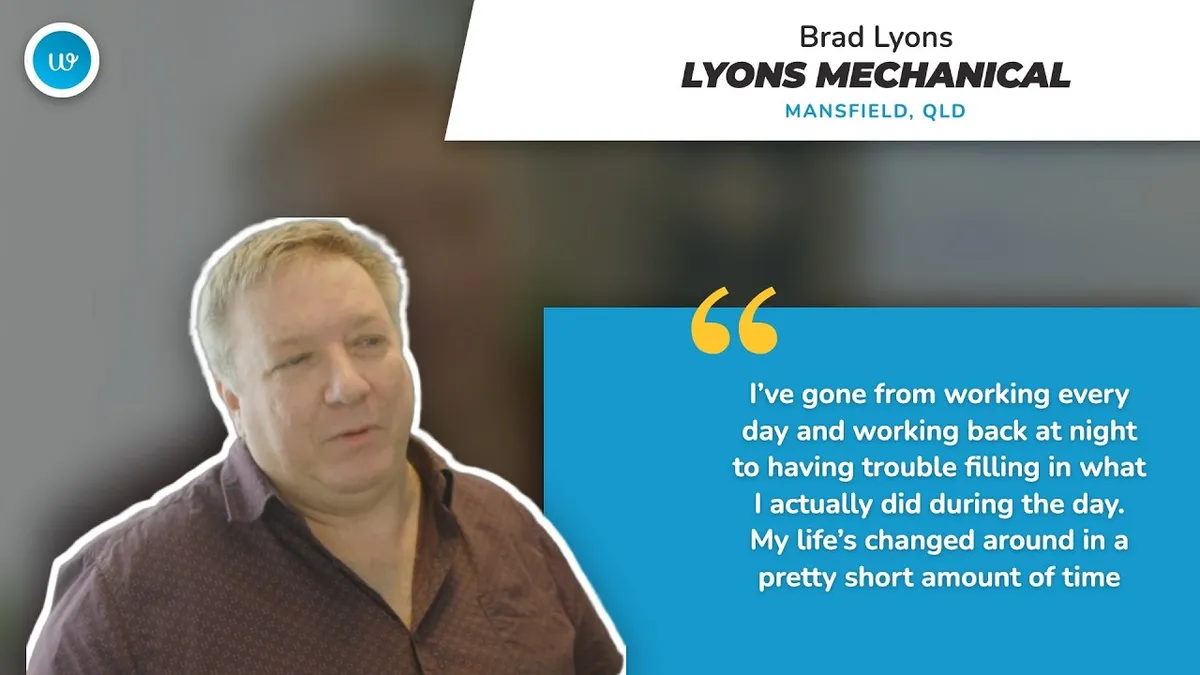
Twenty Years In and Still Doing Everything? Brad Lyons' Turn
Brad Lyons had been running Lyons Mechanical for two decades when he admitted something most owners never say out loud:
"Like all mechanics, I probably thought I knew better."
He is being hard on himself and he is also describing an entire industry. Twenty years of surviving is excellent evidence that you can survive. It is no evidence at all that the way you are doing it is the best way available.
What twenty years had actually built
A business he could not leave.
"I've gone from working every day, working back at night, doing stuff."
Every day, and back at night. That is a job you cannot resign from, dressed as ownership.
And his own verdict on how he thought about it at the time:
"I used to think that I was a pretty bit of a smart ass that we survived for 20 years and we're doing okay."
Why experience makes this harder, not easier
Nobody resists help like somebody who has already proved they can cope.
Twenty years of solving things yourself builds a genuine, earned belief that you are the person who solves things. Every crisis you personally fixed is evidence for it. So when someone suggests the shop could run differently, it lands as a criticism of two decades of effort rather than as an offer.
And the longer it runs, the more the business is literally built around you. Processes live in your head because you were always there to remember them. Customers ask for you because you always took the call. Your team escalate because escalating has always worked.
None of that is a character flaw. It is twenty years of a business organising itself around the one reliable component, which was you.
Which is why Brad's own description of what he did next is the honest one:
"I fought it for as long as I could."
Watch: Brad tells it himself in about two minutes.
What he changed
He did the eight week course first, then events and seminars, then joined the Engine Room after resisting it for as long as he could manage.
Then, in his words, he went back to basics, did a whole lot of things, and it all changed. He has been working closely with me for about twelve months.
He is deliberately vague about which systems, and that is a fair reflection of how it actually goes. It was not one intervention. It was a lot of ordinary things done properly, in order, by somebody who had finally decided to stop improvising.
Where Brad is now
The best outcome in this whole batch of stories, and it arrives as a complaint:
"I had trouble filling in a couple of the questionnaires on what I actually did during the day."
He could not answer the question. Not because the day was chaos, but because the things that used to fill it are now handled by the shop rather than by him.
In his words, his life has changed around a fair bit in a pretty short amount of time, and things have looked really good since.
What back to basics actually means
Brad does not list the systems, so I will, because it is the same list almost every time.
Knowing what an hour costs you to produce, and pricing above it. Reading a profit and loss often enough to notice a trend rather than a disaster. Writing down the jobs that live in your head, starting with the one that gets interrupted most. Giving somebody on the team the authority to answer a question without finding you. And checking a small number of figures weekly rather than annually.
None of that is new and none of it is clever. That is exactly why a twenty year veteran can go two decades without doing it: there was never a week where any single item was urgent.
The compounding is the part that surprises people. Each one gives back a little time, and the time is what lets you do the next one. Which is why the change Brad describes arrives slowly and then, in his words, in a pretty short amount of time.
Which part of this sounds like your shop?
If you have been at it for fifteen or twenty years and still work nights, longevity is not the same as a working business.
If the idea of a coach feels like an insult to what you have already built, that reaction is almost universal among owners who have survived a long time, and it is worth noticing rather than obeying.
If your automotive workshop would struggle without you for a fortnight, the business has been built around a person rather than a system, which is a solvable problem at any age.
Questions auto repair shop owners ask
I've survived twenty years. Why would I change now?
Because surviving and being paid properly for it are different things, and so are surviving and being able to stop. Brad's twenty years were real. They had simply bought him a job rather than a business.
Isn't it too late for me to do this?
Brad was two decades in and the visible change came inside about a year. Experience makes some of this faster, because you already know the trade cold. What was missing was never skill.
What does "back to basics" actually mean?
Pricing you can justify, numbers you look at, and the things in your head written down where a team can use them. It is unglamorous, which is why it gets skipped in favour of something more exciting.
I don't want somebody telling me how to run my shop.
Nobody does, and that is not what happens. What changes is that you get numbers, a plan and somebody who notices when you drift, which is a different thing from being told what to do.
How would I even know if this is my problem?
Try Brad's test. Write down what you did yesterday, hour by hour. If most of it is work your team could have handled, that is your answer.
What to do tonight
Fill in Brad's questionnaire on yourself. What did you actually do today?
Then go down the list and mark each item with the name of the person who could have done it if the shop were set up for them to. The length of that second column is the size of the opportunity, and it has nothing to do with how long you have been trading.
If you want to compare notes with owners in the same position, we run a free Facebook group called Your Profitable Auto Repair Shop. Come and join us.
Where to go next
- Why do I have to do everything myself?
- How to build a shop that runs without you
- Do I need a business coach for my mechanic workshop?
- What systems does a mechanics workshop need first?
Our clients are named auto repair shop owners, and garage owners across five countries, on camera. Plenty of them resisted for years first.
More on this topic: all Systems articles.
Whenever you're ready, here's how we can help.
- Free. Shop Talk, a 30 day reset for auto repair shop owners, and our free resources.
- Under $50,000 a month? Auto Superstars Academy, $997 one off. Your service advisor is the first thing that takes a day back.
- Over $50,000 a month? The Engine Room, where Brad ended up after fighting it, with one on one coaching on demand from a business coach who is a current or former auto repair shop owner.