Paying the Bills But Not Getting Ahead? Alison's Way Out
Alison Richards of Aitkenvale Auto & Dyno in Townsville describes the before in a way that will be uncomfortably familiar:
"We were just floating along. We weren't making any great jumps in income."
And then the part that makes it serious rather than merely frustrating:
"There wasn't any great prospect of having a great retirement. We were just bobbing along."
Bobbing along is survivable for years. That is exactly what makes it dangerous.
Why floating along is so hard to escape
Because nothing about it demands action this week.
The bills get paid. The staff get paid. Something is always arriving. There is no crisis to respond to, so the business absorbs every year without ever compounding into anything, and the owner's own future quietly becomes the thing that is being deferred.
The arithmetic underneath is simple and brutal. A shop that merely covers itself leaves nothing to pay down debt, nothing to put away, and nothing to buy back the owner's time. So year twelve looks like year three, with older equipment and a more tired owner.
And because the shop is not failing, nobody intervenes. Failing shops get help. Floating ones get another year.
The thing that breaks it is usually not a tactic. It is deciding that "fine" is not the target.
What she changed
Alison is honest that there was no clever trick, and the honesty is worth more than a method list would be.
Showing up and doing the work. In her words: "You've got to show up, put in the hard yards."
And not doing it alone. What she names as the difference is "having somebody and a group of people that know what you're going through".
That second one is easy to dismiss and hard to replace. An owner floating along has nobody telling them that floating is a choice. Peers who have made the same decisions do that without being asked.
Her view on the alternative is blunt:
"If you're not prepared to do that, well, you're going to look at being either mediocre in business and just either bob along or fail."
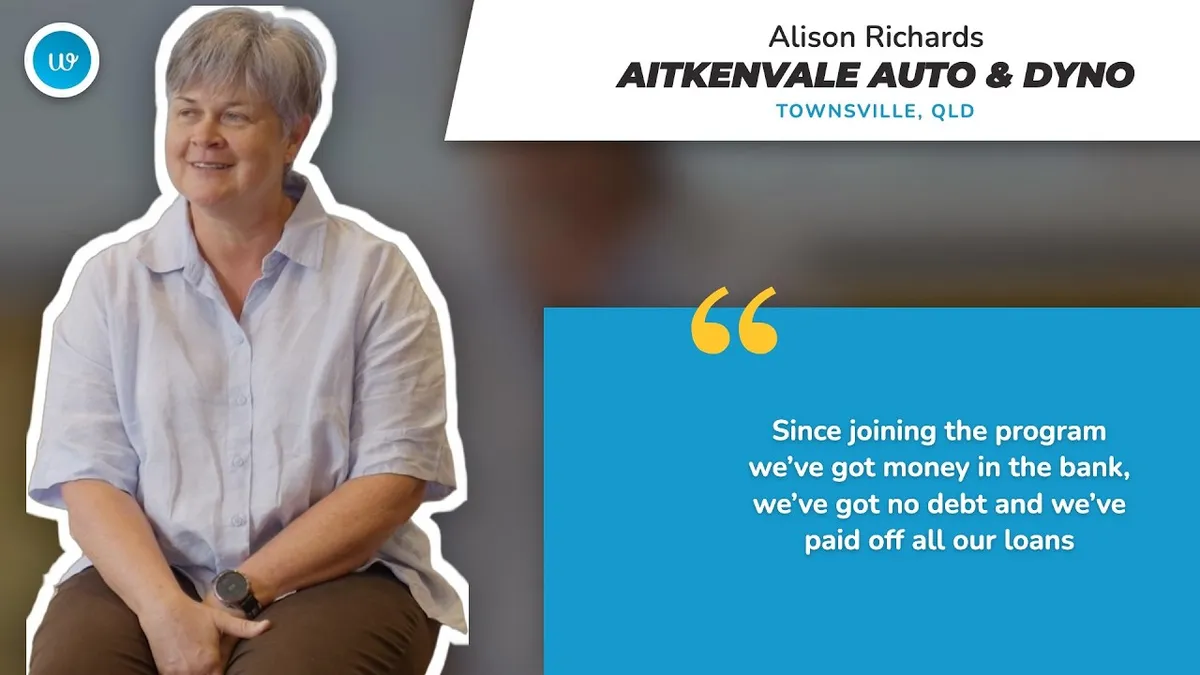
Watch: Alison tells it herself in under three minutes.
Where Aitkenvale is now
"Our biggest win since joining the program has been we've got money in the bank. We've got no debt. We have paid off all our loans."
Money in the bank. No debt. Every loan paid off.
And the one that matters most, which has nothing to do with the shop:
"It takes such a weight off your shoulders. We're looking down the barrel of retirement."
They now expect a better retirement because of it. For an owner who had no real prospect of one, that is the whole return.
What floating actually costs
It is worth doing the arithmetic once, because floating has no obvious price tag.
A shop that breaks even pays its bills and leaves nothing. Over ten years that is ten years of equipment ageing, no debt cleared, and nothing put aside. The owner arrives at the point where they want to stop with a business that cannot be sold for much, because it does not produce a profit a buyer could rely on, and no savings outside it either.
A shop producing even a modest surplus does something different. Debt clears, which lowers the cost of running it, which increases the surplus. Equipment gets replaced from cash rather than finance. And the owner ends up with something that is worth selling and the option not to.
The two shops can look identical from the road for a decade. The difference only becomes visible at the end, which is precisely when it is too late to change it.
Which part of this sounds like your shop?
If the bills get paid and nothing accumulates, you are floating, and floating has a cost that only shows up at the end.
If you could not say what the business will have produced for you by the time you want to stop, nobody is steering towards that.
If you are the only person who knows how hard this is, that isolation is doing more damage than you would guess.
Questions auto repair shop owners ask
Is paying off debt really the best use of the money?
It is the most reliable return available to most shops, because the interest is certain and the alternative uses are not. It also changes how the business feels to run, which is worth something on its own.
My shop is fine. Why change anything?
Because fine does not compound. A mechanics workshop that merely covers itself leaves nothing for debt, retirement or buying your time back, and the years pass at the same rate either way.
I don't have anyone to talk to about this.
That is the most common thing owners say and the easiest of these problems to fix. Other owners in the same position are not hard to find, and Alison names that group as the difference.
How long before this shows up in the bank?
She does not put a timeframe on it, and neither will I. What she is describing is several years of consistent work rather than a quick turnaround.
I'm near retirement. Is it too late?
Alison's result is a retirement that is now worth having, from a position where there was no real prospect of one. Later is harder. It is not too late.
Do I need a big month to start getting ahead?
No, and waiting for one is how a decade passes. A modest surplus applied consistently clears debt, and clearing debt lowers what the business costs to run, which increases the surplus. It compounds quietly in exactly the way floating does, only in the other direction.
What to do tonight
Write down one number: what you want the business to have paid off, and by when.
Not a revenue target. A debt, cleared, by a date. Then work out what it needs to produce each month to get there.
If that number is bigger than what the business currently produces, you have found why the floating continues, and that is a pricing and systems conversation rather than an effort one.
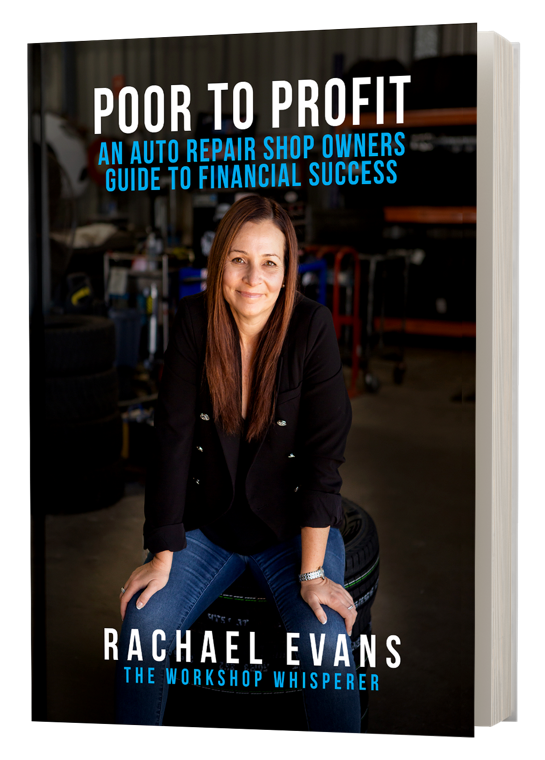
If your numbers have never quite made sense, start with Poor to Profit. It is free.
Where to go next
- Why isn't my auto repair shop paying me?
- How to fix cash flow in your auto repair shop
- Why am I busy but not making any money?
- Is business coaching worth it for an auto repair shop?
Our clients are named auto repair shop owners, from automotive workshops and garages across five countries, on camera, telling you what changed.
More on this topic: all Money & Profit articles.
Whenever you're ready, here's how we can help.
- Free. Shop Talk, a 30 day reset for auto repair shop owners, and our free resources.
- Under $50,000 a month? Auto Superstars Academy, $997 one off. Your service advisor is where the margin that clears debt is won.
- Over $50,000 a month? The Engine Room, where Alison found the group she credits, with one on one coaching on demand from a business coach who is a current or former auto repair shop owner.