

How Do I Have a Tough Conversation With My Team?
You already know which conversation this is about.
It has a name attached to it, you have rehearsed the opening line in the car more than once, and you have found a reason not to have it for somewhere between three months and three years.
The good news is that the difficulty is not a character problem. It is a preparation problem, and there is a method for it.
Why you keep putting it off
Dean has a model for this that explains the delay better than willpower ever will.
Every owner is working two pedals at once. The accelerator is what you are running towards: the profit, the four day week, the business that runs without you. The brake is everything you are running away from, and it is usually made of specific, nameable things.
"It's the cash crunch. It's the phone that never stops ringing. It's the difficult conversation you've either got to have with a team member, with your accountant, maybe with your spouse, but you just keep putting it off."
The conversation is the brake. Not a symptom of the brake. The brake itself.
And the reason that matters is that you can press both pedals as hard as you like and the business will not move. It will make an enormous amount of noise, burn through you, and sit exactly where it was.
"You're not stuck because you're not working hard enough. You're stuck because you're pushing on both pedals at the same time."
Any mechanic can diagnose that car in thirty seconds from the smell alone. The same diagnosis on your own business is harder to make, because from the inside the effort feels like progress.
Watch: Dean walks through the whole model, on you and then on a team member.
What the avoided conversation is actually costing
Put a number on it and the delay stops looking free.
Rachael's figure, from our episode on underperforming staff, is that an underperforming technician is often selling only half their hours. Not half their effort. Half their hours, invoiced.
Say that technician is paid for 38 hours a week and sells 19 of them. At a labour rate of $150, the 19 hours that never reach an invoice are $2,850 a week. Across 48 working weeks that is about $136,000 a year, from one bay, with somebody standing in it all day.
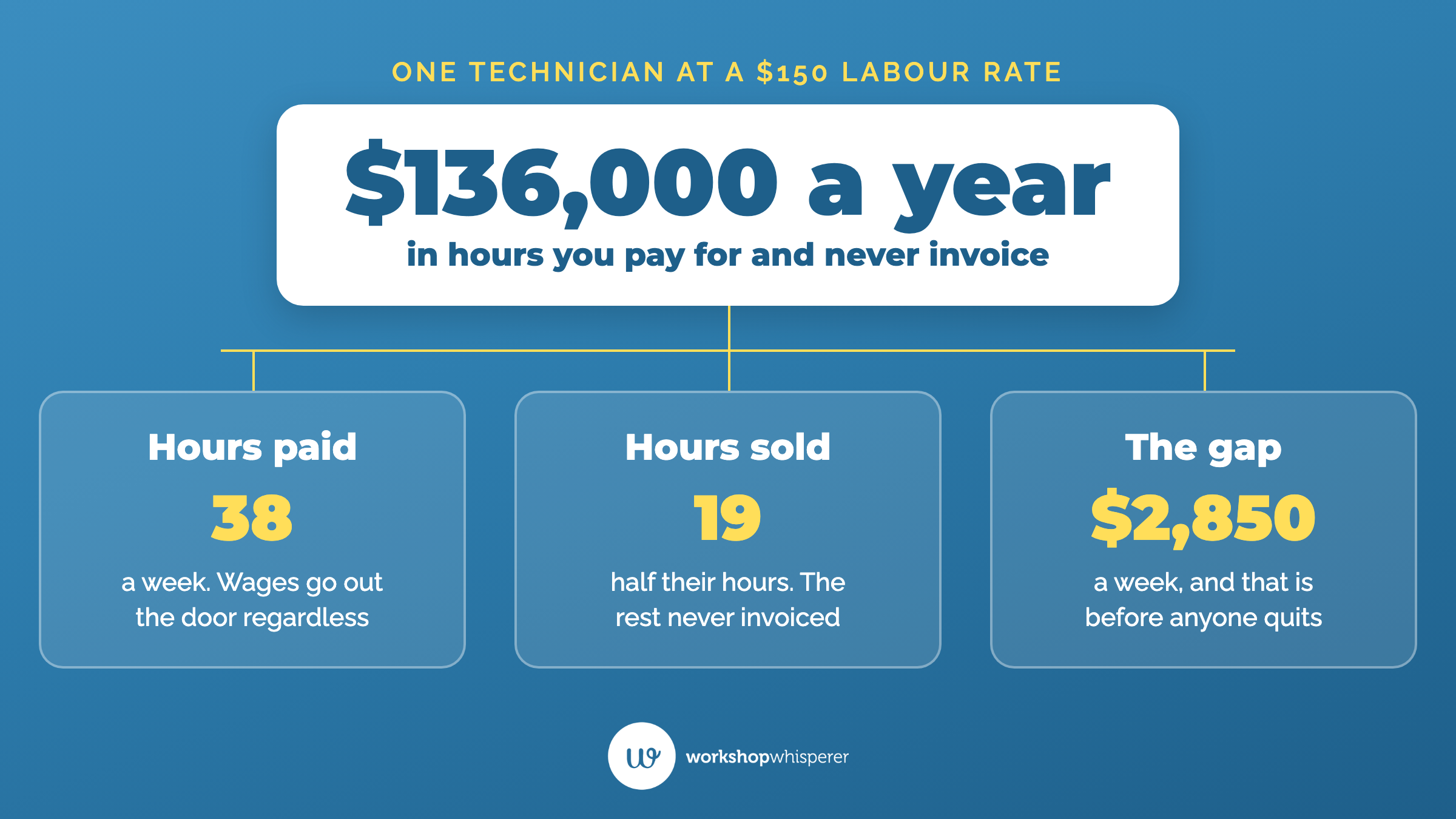
That is the visible half, and in a mechanics workshop running three or four bays it is the difference between a good year and a bad one. The other half does not appear on any report at all. Your good technicians can see exactly what is happening, and when it is tolerated month after month they draw the only available conclusion about what standards mean here. The person you lose to a tolerated underperformer is almost never the underperformer.
So the arithmetic of the delay is not "an uncomfortable hour versus a quiet week." It is an uncomfortable hour versus a six figure leak and your best person's resignation.
Why a script is the wrong preparation
The instinct is to write down what you are going to say. Dean is blunt about why that fails.
"It's not about giving you a script, because while we could give you your script, when you go and have the conversation the truth is they will have a different version of their script. And if they don't say what you think they should say, you feel like you're losing control."
A script survives exactly one unexpected sentence. What you need instead is a structure, because a structure tells you where to go next no matter what they say.
He compares it to martial arts. You do not memorise a fight. You drill a small number of moves until you can use them from any angle, and that is what lets you stay calm when something arrives that you did not plan for.
The four steps: situation, problem, impact, need
This is the model we teach our Engine Room owners. It is four steps, in order, and the order is the part people get wrong.
Step one. Start with the situation, not the problem.
Open by describing the situation rather than listing what has gone wrong. Where the business is at, what is ahead of it, what you are both working inside.
Then use one of three words deliberately: respect, appreciate, understand.
"I respect what you might be feeling right now." "I appreciate the pressure you have been under." "I understand this has been a difficult few months."
This is not softening the blow and it is not a technique for being liked. It validates the other person's emotion before you ask them to think clearly, and as Dean puts it:
"It is certainly much harder to engage in an argument or fight someone who agrees and acknowledges the situation that you find yourself in."
Most conversations that go badly went badly in the first thirty seconds, because they opened with the accusation.
Step two. Name the problem, specifically.
Now the problem, and here the rule is specific rather than general.
"Your productivity is not where it needs to be" is general, and it is arguable. "Over the last six weeks you have averaged nineteen billable hours against a target of thirty" is specific, and it is not.
You do not have to open the books. You do have to be exact about the area, because a general complaint invites a general defence and nothing moves.
Step three. Reveal the impact, in this order.
The impact of nothing changing, named for three parties in a fixed sequence: on them first, then on the business, then on you.
The order is deliberate and almost everybody gets it backwards. Owners open with what it is doing to them, which sounds like a grievance. Opening with what it costs the person in front of you sounds like what it actually is, which is a warning you are giving them in time to act on it.
Their half might be a career that is stalling, a trade they are not finishing, a reputation among the other technicians. The business half is the hours, the bookings, the customers. Your half goes last and it is short.
Step four. Agree what is needed, both ways.
Finally, what needs to happen. Two directions, not one: what you need from them, and what they need from you.
That second half is what turns a telling off into an agreement. Most underperformance has at least one input the owner controls, whether that is training, a tool, clearer priorities or somebody stopping the interruptions.
What you are after at the end is a short list of agreements with a timeframe on them, written down, that you both follow through on. Certainty is the thing people actually want out of a hard conversation. Even bad news, clearly stated with a plan attached, settles someone down faster than another month of being unsure.
The reframe that makes it possible
Dean's line about what this changes is the one worth keeping.
"You're not accusing them of anything. You're actually diagnosing a gap in their performance. And once that gap is named, then together you can actually do something about it."
Before this, an owner looking at an unproductive technician who is visibly busy all day has two options available, and both are bad: decide the person is lazy, or decide they are not trying. Neither can be said out loud, which is precisely why the conversation keeps getting deferred.
The four steps give you a third option. You are not there to deliver a verdict. You are there to find out what they are working towards, what they are avoiding, and whether those two things are pulling against each other the same way yours are.
That is a conversation you can actually start.
Questions auto repair shop owners ask
What if they get angry or upset?
Expect it, and do not treat it as the conversation failing. Go back to step one and acknowledge the situation again. You cannot reason with somebody while they are still emotional, and the respect, appreciate, understand language exists for exactly this moment rather than only for the opening.
Should I have someone else in the room?
For performance conversations, usually not. For anything that could lead to dismissal or involves a complaint about conduct, yes, and take notes. If you are anywhere near that line, get proper advice before the meeting rather than after it.
How long should the conversation take?
Less time than you think. Each of the four steps is a short piece of a conversation rather than a speech. What takes the time is the agreement at the end, which is the part most owners rush.
What if nothing changes afterwards?
Then you have a different conversation, and it is an easier one, because you have written agreements with a timeframe. A second conversation that references a specific commitment is far simpler than a first conversation about a vague feeling.
Can I do this over the phone or by message?
No. Tone does most of the work in steps one and three, and a message strips all of it out. It also removes their chance to respond, which is the only part that makes it an agreement rather than an announcement.
What to do tonight
Write down the conversation you have been avoiding. One line, with the person's name in it.
Then write the four headings underneath it and fill them in: the situation, the specific problem, the impact on them and on the business and on you, and what you need from each other.
That is the whole preparation. Not a script, four headings, and it takes about fifteen minutes.
Then put it in the diary for this week, because a prepared conversation that never gets booked is still the brake.
If you want to compare notes with owners working on the same thing, we run a free Facebook group called Your Profitable Auto Repair Shop. Come and join us.
Where to go next
- How to deal with an underperforming technician
- How to handle a customer who is angry about the bill
- How to hold your team accountable without micromanaging
- How to build a team that takes ownership
- How to delegate when your team keeps making mistakes
Our clients are named auto repair shop owners, from automotive workshops and garages across five countries, on camera, telling you what changed.
More on this topic: all Culture & Meaning articles.
Whenever you're ready, here's how we can help.
- Free. Shop Talk, a 30 day reset for auto repair shop owners, and our free resources.
- Under $50,000 a month? Auto Superstars Academy, $997 one off, and Superstar Service Advisor at $197 if the counter is where your hard conversations happen.
- Over $50,000 a month? The Engine Room, where we teach this model, with one on one coaching on demand from a business coach who is a current or former auto repair shop owner.