
All My Mechanics Quit at Once. How Mick Rebuilt His Team
Mick Manzi at M&R Auto Care in Sandgate lost nearly everyone. In his words, "I had basically pretty much all my staff except for one left."
What he did next is the part worth reading, because he did not start with recruitment.
What it was like before
"I was running around like a headless chook all day, every day, chasing every staff member in my business, answering phones, dealing with customers."
And the thing underneath it, which owners mention far less often than they feel it:
"I just felt really isolated. I didn't really have anyone to sort of lean on."
Isolated is the word a lot of owners of a mechanics workshop would use if anybody asked. You are the only one in the building who carries the whole thing.
What he found when he looked for the cause
Mick did something uncomfortable. Instead of concluding the staff market was bad, he went looking for what he could change, and he kept arriving at the same answer:
"It was like, right, okay, I need to work on. But what do I need to work on? And it just kept coming back to my leadership."
That is a hard sentence to say out loud about your own shop. It is also the one that makes everything after it possible, because leadership is the only variable on that list you fully control.
What he changed
Rewrote all the contracts. Clear terms, clearly agreed.
Added processes, a lot of them, so the work did not depend on him remembering.
Learned the numbers, and started making decisions from the financials rather than from feel.
Introduced the parts matrix, which is a structured way of pricing parts by band rather than applying one markup to everything.
What the parts matrix did
This is the result most owners will not expect, and it is the best argument for pricing work I know:
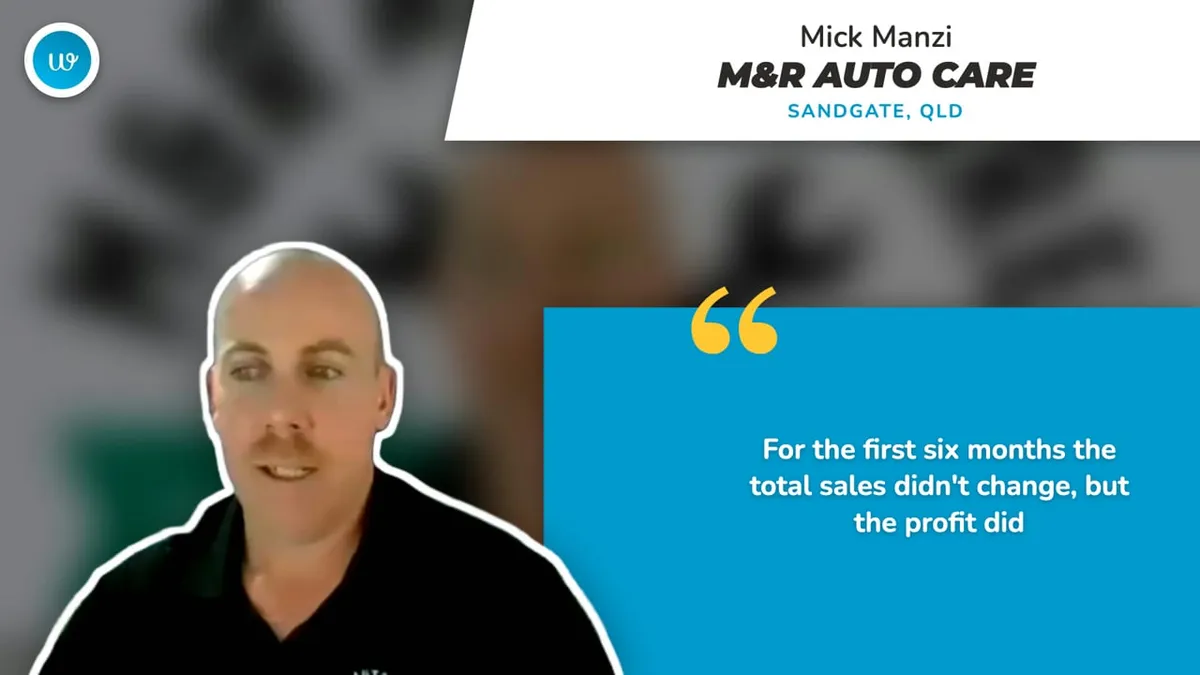
"The total sales within my business, probably for the first sort of six months or so following that, the total sales didn't change, but the profit did."
Same cars. Same customers. Same revenue. More profit.
Nothing about that required winning a single new customer, which is why pricing is almost always the faster lever than volume.
Where M&R Auto Care is now
Towards the end of 2024 it was Mick and one mechanic. Now it is a service advisor, Mick, and three mechanics. The rebuild took three to six months.
Total sales are now going up as well, on top of the profit improvement.
And there is a line that tells you more about where he has got to than any number:
"Don't want to sound cocky, but some days I'm a little bit bored."
An owner with time on their hands in an automotive workshop that is growing. That is the whole point of the exercise.
Why a team leaves all at once
People rarely leave a mechanics workshop one at a time for unrelated reasons. They leave in clusters, and the cluster is the signal.
What usually happens is that conditions deteriorate slowly, everyone absorbs it, and then one person moves. That first departure does two things: it increases the load on everybody left, and it proves that leaving is possible. The second resignation follows faster than the first, and the third faster again.
By the time an owner is down to one mechanic, the instinct is to blame the labour market, because that explanation requires nothing to change. It is also the explanation that guarantees a repeat, since new people arrive into the same conditions that emptied the place.
Mick's answer is harder and more useful. He looked for what he controlled and kept landing on his own leadership. That is not a comfortable conclusion, and it is the only one that gives you something to do on Monday.
The things he changed afterwards follow from it. Contracts, so expectations are written rather than assumed. Processes, so the work does not depend on him remembering. Numbers, so decisions come from the financials instead of the mood of the week.
Which part of this sounds like your shop?
If you are chasing every team member, answering every phone and handling every customer, that is the headless chook stage, and it is a design problem rather than an effort problem.
If people have left and you have concluded the labour market is the issue, Mick's answer is worth sitting with before you post another ad.
If you apply one markup across every part, the matrix is probably the fastest profit available to you this quarter.
Is this one shop getting lucky?
Mick's rebuild is not a one-off, and the reason matters more than the result.
Across thirteen years, more than 10,000 auto repair shops in five countries and over $175 million in additional profits generated for owners, the pattern repeats: the shops that recover are the ones where the owner looks at what they control first.
That is the uncomfortable part and it is also the hopeful part. A labour market you cannot change leaves you waiting. Leadership, contracts, processes and pricing are all things you can start on this week, in your own automotive workshop, without anybody's permission.
Questions auto repair shop owners ask
Everyone left. Isn't that just bad luck?
It can be. It is worth checking the other possibility first, because if the cause is in the shop, hiring replacements puts new people into the same conditions.
What is a parts matrix?
A banded pricing structure, so a cheap part and an expensive part are not marked up by the same percentage. It reflects the fact that the work and risk attached to a part do not scale with its cost.
How long does rebuilding a team take?
Three to six months for Mick, and that was with contracts and processes going in at the same time. Rebuilding faster usually means rebuilding the same problem.
I feel completely on my own with this.
That is extremely common and almost never said out loud. It is also the easiest of these problems to fix, because other owners in the same position are not hard to find.
Will my customers notice a pricing change?
Mick's sales did not drop. Most owners expect a reaction that does not come, which is worth remembering before you decide you cannot move.
What to do tonight
Write down the last three people who left, and next to each, the reason they gave you. Then write what you think the real reason was.
If those two columns do not match, the gap is where the work is, and it probably is not in your job ads.
If you want to compare notes with other owners, we run a free Facebook group called Your Profitable Auto Repair Shop. Come and join us.
Mick is one of many. Our clients are named auto repair shop owners, and garage owners across five countries, on camera, telling you what changed.
Where to go next
- How to keep good technicians and apprentices
- How to markup or margin on parts
- How to build a team that takes ownership
- How to the numbers to check every week
More on this topic: all Culture & Meaning articles.
Whenever you're ready, here's how we can help.
- Free. Shop Talk, a 30 day reset for auto repair shop owners, and our free resources.
- Under $50,000 a month? Auto Superstars Academy, $997 one off. Your service advisor is where parts pricing is held at the counter.
- Over $50,000 a month? The Engine Room, where Mick did this work, with one on one coaching on demand from a business coach who is a current or former auto repair shop owner.